Splatchinko Turns Your Eyeballs Into a $9.51 Planet-Demolition Project
Someone has kidnapped your beloved, and apparently the proportionate response is to fire your eyeballs through several civilizations. Splatchinko gives its alien protagonist an excellent excuse for terrible behaviour: this former devourer of worlds discovered love, briefly became peaceful, and now has to resume planetary destruction on romantic business.
I like a rescue mission that raises immediate questions about whether the rescuer should be allowed near the person being rescued.
That is the hook behind Stupidi Pixel's new game, published by Stratos Gaming, with a listed release date of Nov 11, 2026. As of November 12, it is a fresh release priced at $9.51 on windows. Its official pitch combines turn-based decisions, pachinko-inspired physics and incremental roguelike builds.
The interesting proposition is the collision between choosing a shot carefully and watching an eyeball make a series of increasingly irresponsible connections.
Love means never having to spare a planet
The premise works because the alien's tenderness and appetite for destruction appear to coexist quite comfortably. This is not a misunderstood creature reluctantly learning violence. According to the listing, consuming worlds was already part of the routine before romance interrupted it. The kidnapping supplies permission to return to an old hobby, with a rescue objective attached to the wreckage.
That joke also gives the mechanics somewhere to live. A projectile that rebounds through enemies would be serviceable on its own; making that projectile one of your increasingly numerous EYES turns a familiar aiming problem into bodily nonsense. The capital letters belong to the game's terminology, and they suit an alien whose equipment choices seem to involve acquiring additional organs.
The pixel-art presentation and cosmic setting promise room for that absurdity, but the premise earns attention without needing a claim about spectacle. An eye is both an aiming instrument and ammunition. That is a properly economical joke, and it makes Splatchinko easier to remember than another vaguely magical ball bouncing through another vaguely dangerous dungeon.
Aim carefully; the eyeball has other plans
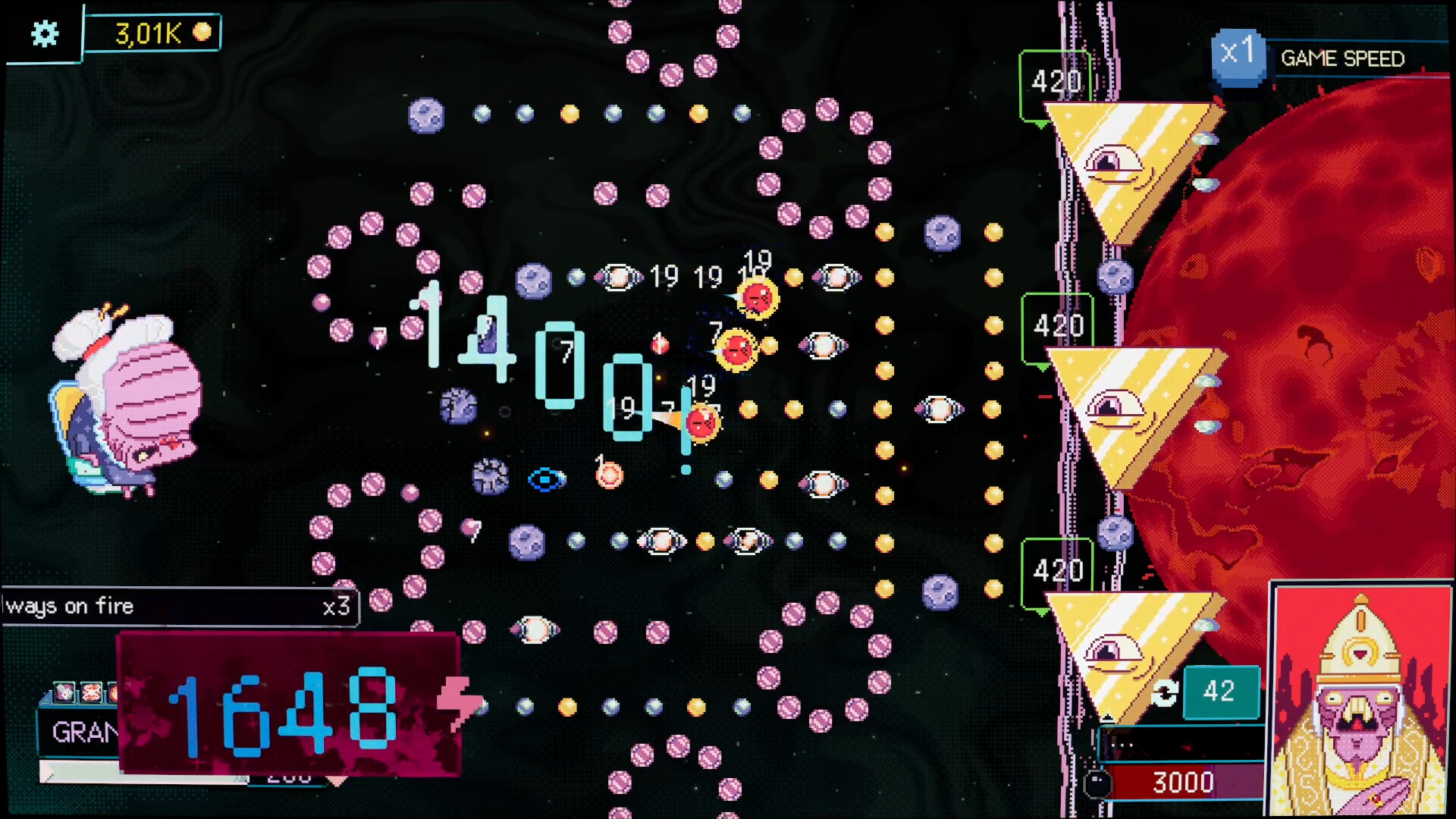
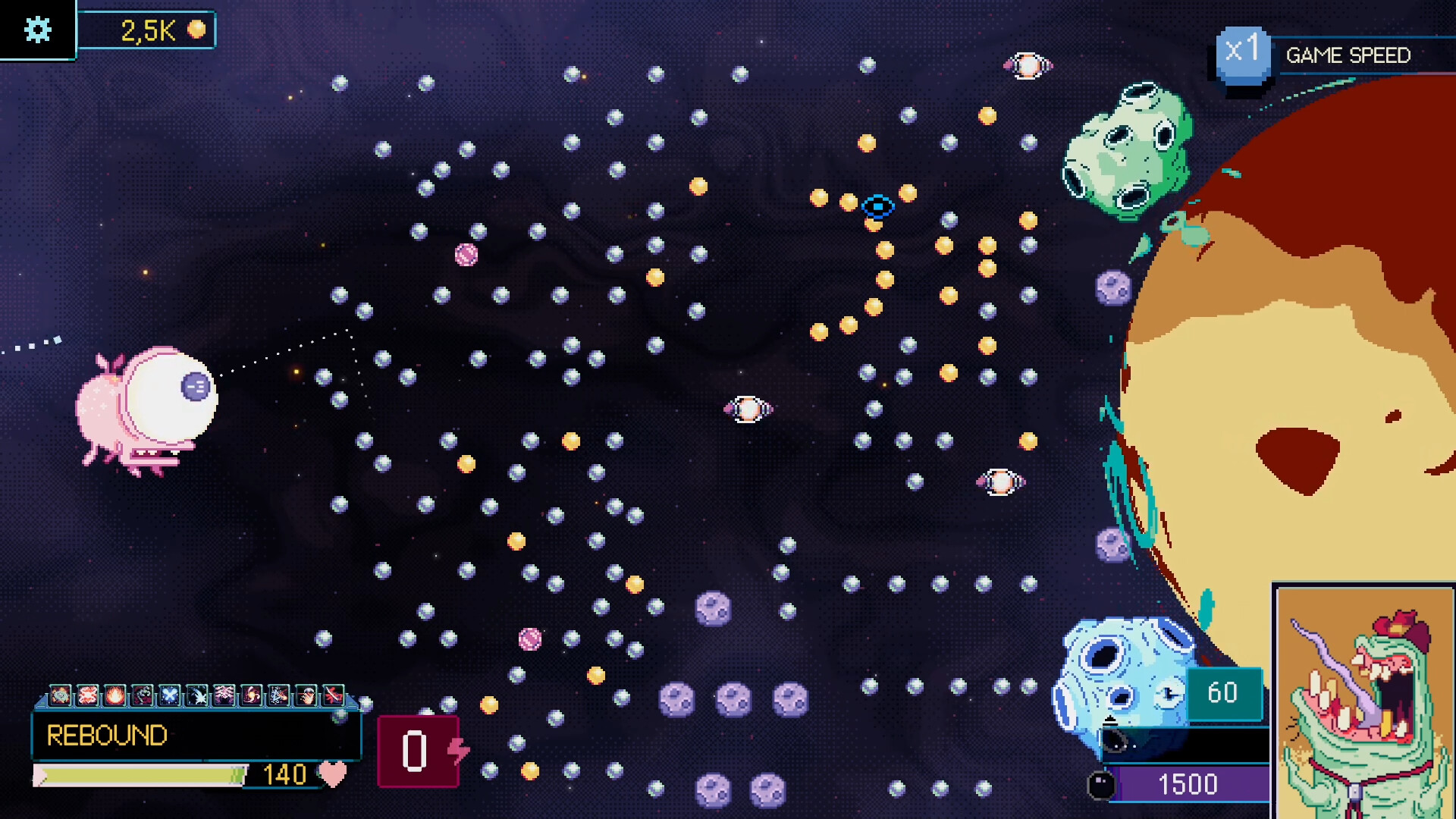
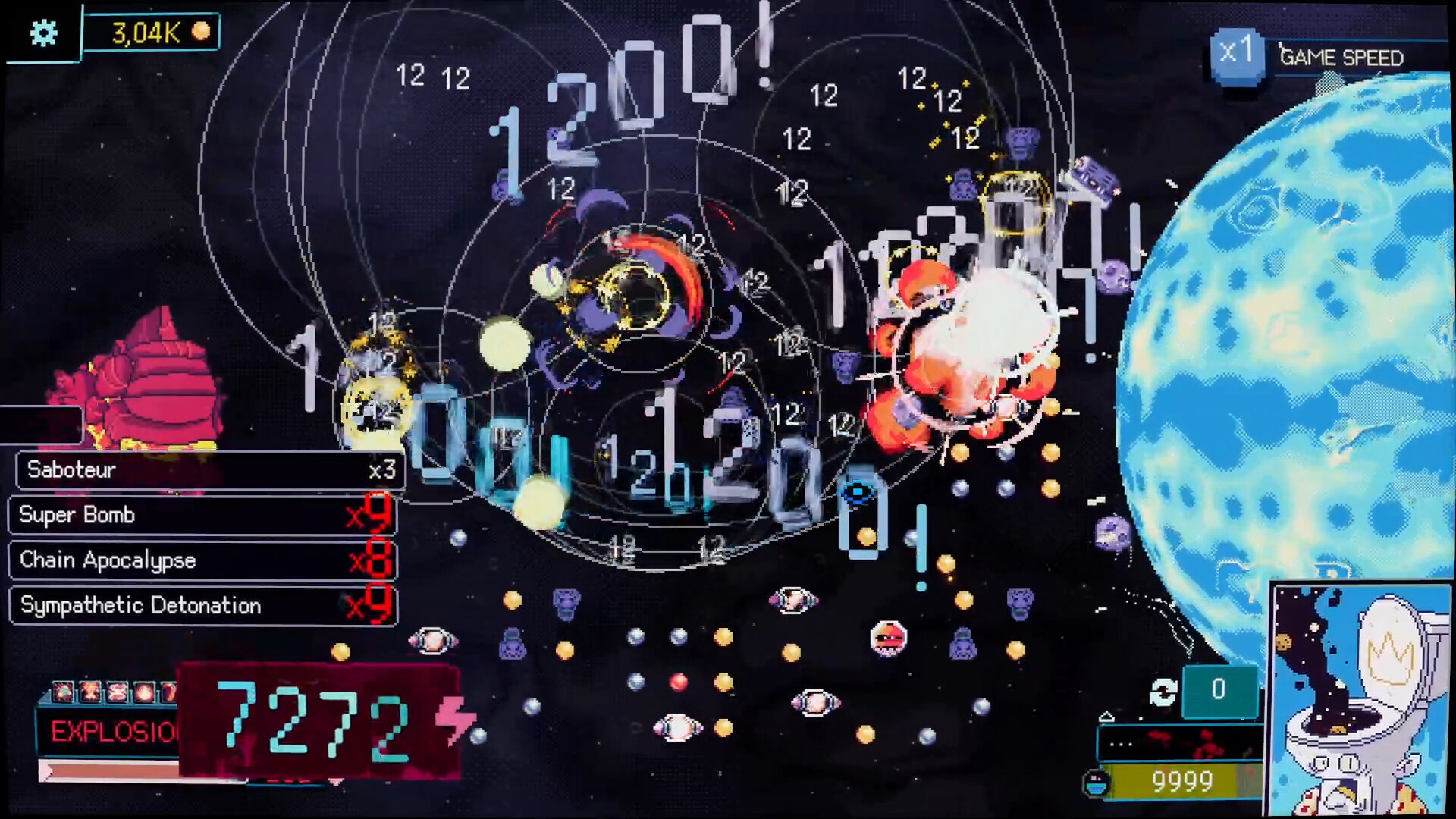
The basic action is concrete. You launch an EYE across a battlefield containing pegs, enemies, obstacles and explosive opportunities. It ricochets across the board, and hitting more targets increases the damage dealt. Choosing a trajectory therefore means considering the shape of the battlefield and the possible chain of contacts, rather than merely pointing at whichever enemy looks least agreeable.
Because the game is turn-based, its appeal rests on the decision before the launch as well as the consequences afterward. The listing describes rebounds, special effects and destructive abilities feeding into one another. The promising moment is the one where a plausible opening angle becomes a much larger event: several contacts, an effect triggered, damage multiplied through a route you hoped would work.
That is the pleasure the design is selling; I cannot claim to have tested how reliably it delivers it.
Peggle is the useful comparison for understanding why a single launch might hold your attention. Splatchinko's stated distinction is what surrounds that launch: enemies, damage, mutable EYES and builds that change how shots behave. The question is not simply whether the projectile reaches something useful. It is whether the projectile you have assembled can make this particular arrangement of targets unusually profitable.
There is a tension here that deserves scrutiny. The listing invites you to predict the shot while joking that physics has stopped taking responsibility. Uncertainty can make a rebound exciting, but strategy needs consequences you can understand. If a disastrous launch leaves you thinking about a better angle, the system has something. If it merely leaves you blaming the board, the joke will wear thin.
That balance remains an open question, not a quality I can certify from a description.
Your build needs a disturbing number of eyes
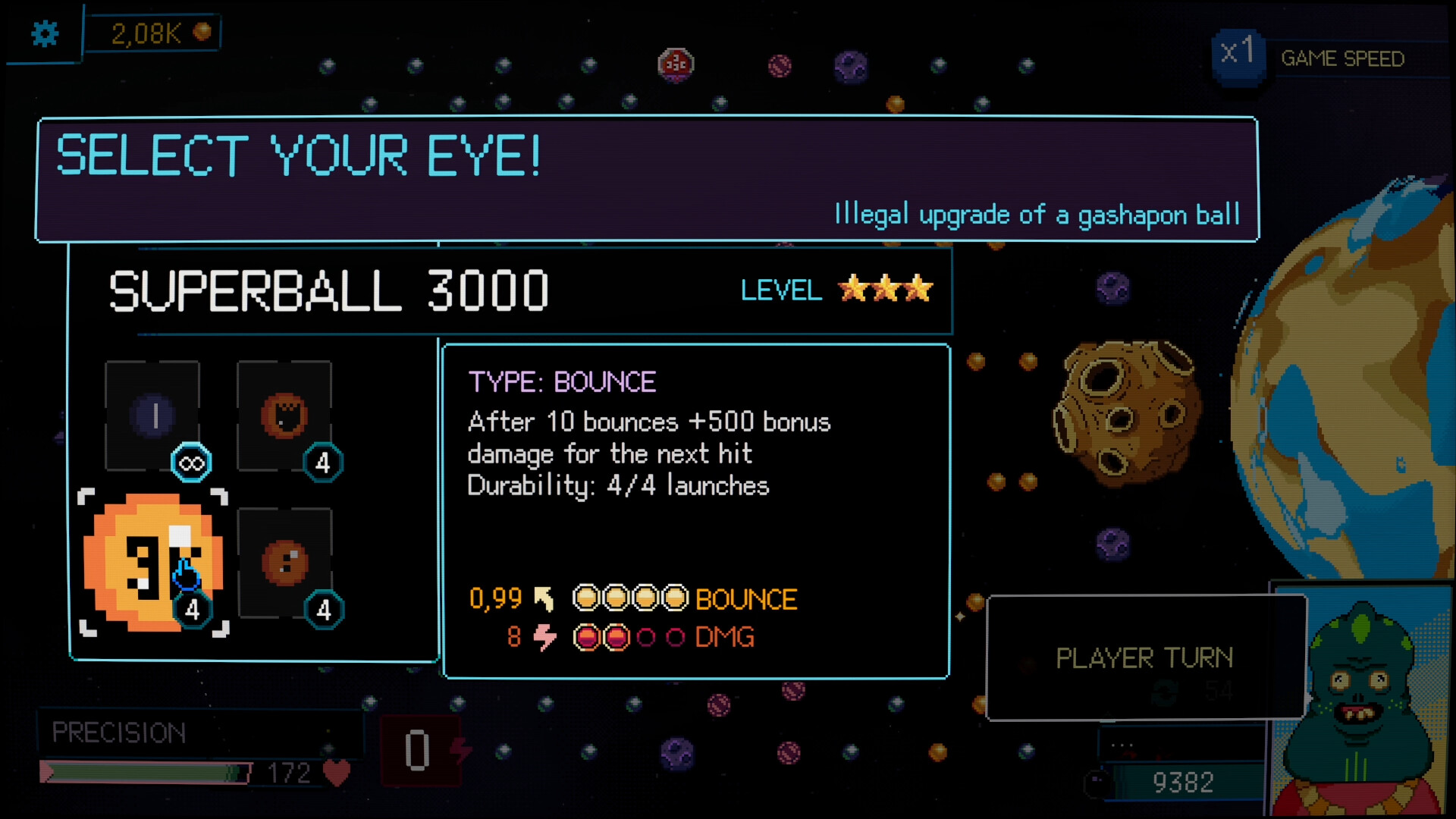
EYES are the main source of variation described for each run. Discovering them grants abilities and changes shot behaviour, including damage, rebounds, status effects and interactions with the battlefield. You can upgrade favourite abilities, so the promise extends beyond collecting a sequence of unrelated novelties. There should be decisions about which useful behaviour deserves further investment.
Balatro is a helpful comparison at the level of appetite: the attraction of assembling interactions that make an ordinary action do something unreasonable. Here, the action being transformed is a physical launch. A build has to express itself through a trajectory and a board full of objects.
That gives Splatchinko a specific challenge: upgrades need to change what you want to aim at, or how you expect a shot to travel, as well as making the resulting numbers larger.
The official description leaves room for that distinction. An EYE that affects rebounds potentially changes the route you seek; one that affects status effects potentially changes which contact matters most. Those are possibilities suggested by the listed systems, not verified examples of particular items. The strongest version of this design would make collecting an EYE alter your next decision immediately.
Mere numerical escalation would be a thinner reward for such an agreeably grotesque premise.
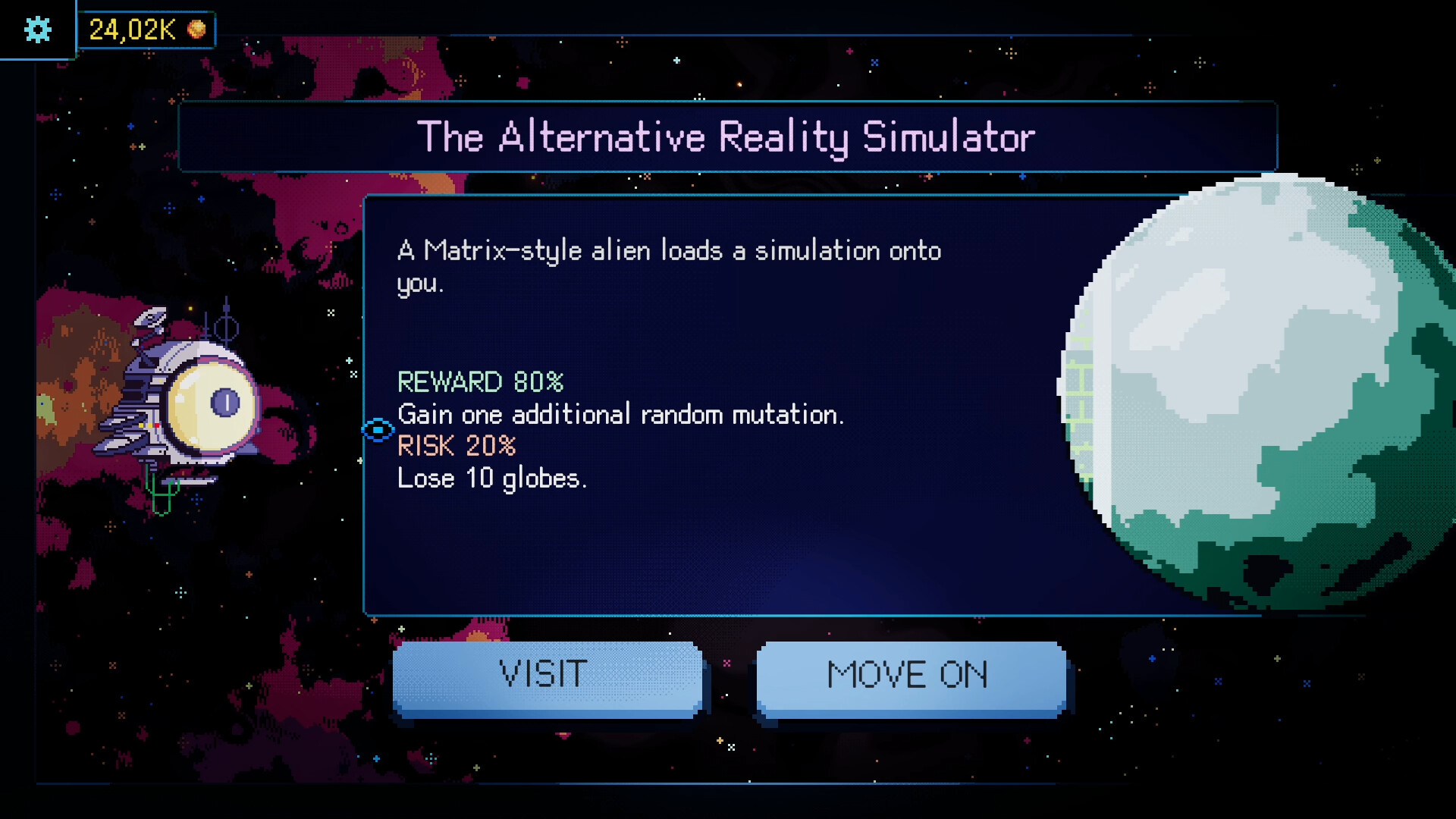
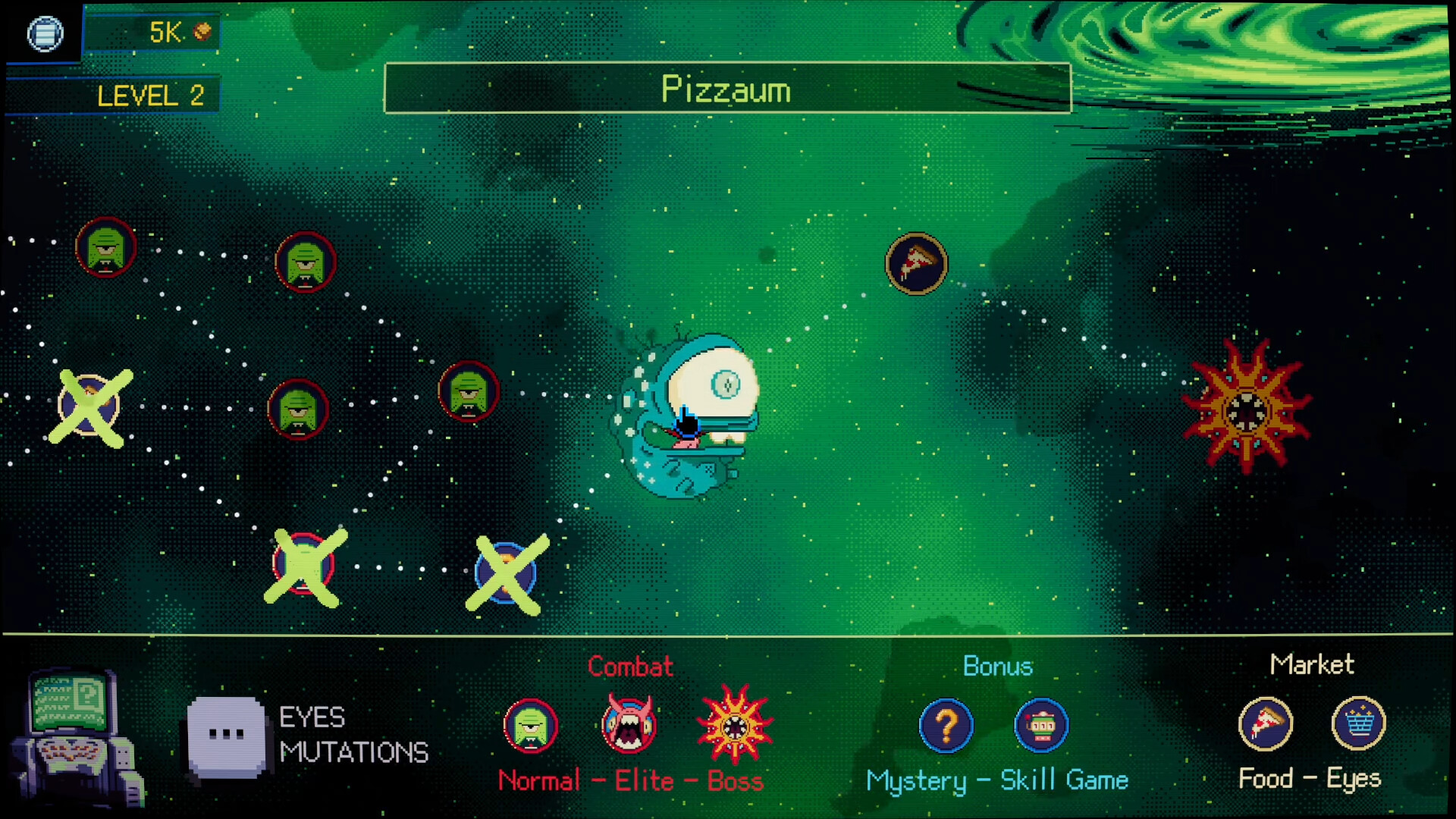
Runs also use branching maps with planets, battles, rewards, shops, bosses and third-contact encounters. That gives the aiming decisions a second scale: choosing where to travel and which opportunities to pursue. The listing explicitly connects those choices to available upgrades and preparation for later challenges. What it does not establish is a permanent progression system between runs.
I would not buy it assuming there is a separate ladder of lasting unlocks simply because the word “incremental” appears in the pitch.
A launch is a reason to look, not proof of a hit
The reason to feature Splatchinko this week is precise: its listed Nov 11, 2026 release puts it one day into launch as of this article, and its central combination is immediately legible. A lovestruck planet-eater firing upgradeable eyes through pachinko battlefields is a stronger invitation than a string of genre tags. It offers a particular action to imagine and a particular kind of build to want to break.
The supplied Steam snapshot shows 2 current players. That is the only audience number available here, and it does not demonstrate a breakout. A concurrent count is a momentary reading, not a sales total or a count of everyone who has tried the game.
Two players gives this spotlight a discovery argument, not a popularity argument: this is a newly released oddity worth examining before there is much supplied evidence of an audience.
No total review count, review score or discount is provided, and there are no supplied player quotations to report. Consequently, there is no defensible claim here that players are praising the builds, forgiving the physics or finding exceptional replay value. Those would be useful answers, but inventing a reception around two concurrent players would turn a small launch into a fictional success story.
The pitch has to carry the recommendation for now.
At $9.51, the purchase question is whether this particular mixture interests you enough to investigate without an established reception in the available evidence. The listing does not give a run length, campaign duration, or counts of EYES, bosses or battlefields. Branching routes and different builds suggest reasons to return, but they do not tell us how much distinct material those returns will uncover.
The price is concrete; the content volume remains unquantified.
Come for the ricochets, stay if the decisions matter
Splatchinko looks best suited to someone who enjoys pausing over an angle, committing to it, then seeing a build turn that decision into a mess. Its stated turn-based structure makes it an interesting prospect for the player who wants escalating destruction with room to consider the next move.
The important attraction is the partnership between planning and physical uncertainty, with the alien romance supplying a suitably foolish reason to keep travelling.
Treat this as a proposition for your own run. The provided official text describes one alien, its collection of EYES and its route through the galaxy; it does not establish co-op or any other multiplayer mode. Anyone shopping specifically for a shared session should verify that requirement before buying.
Likewise, players who need precise, repeatable shot outcomes should approach cautiously: chaotic ricochets are central to the advertised appeal, and the available description cannot settle how readable they feel.
My interest comes down to one design promise: an upgrade should make me reconsider the board. If a new EYE changes the value of a rebound, an obstacle or a chain of targets, Splatchinko has a compelling reason to combine its systems. That is enough to make this tiny launch worth a look, with the limits of the evidence kept visible. Somewhere across the galaxy, a kidnapped beloved is waiting.
Their rescue appears to depend on excellent geometry and an appalling tolerance for collateral damage.