Gestalt Journey Turns Psychotherapy History Into a $6.99 Clicker
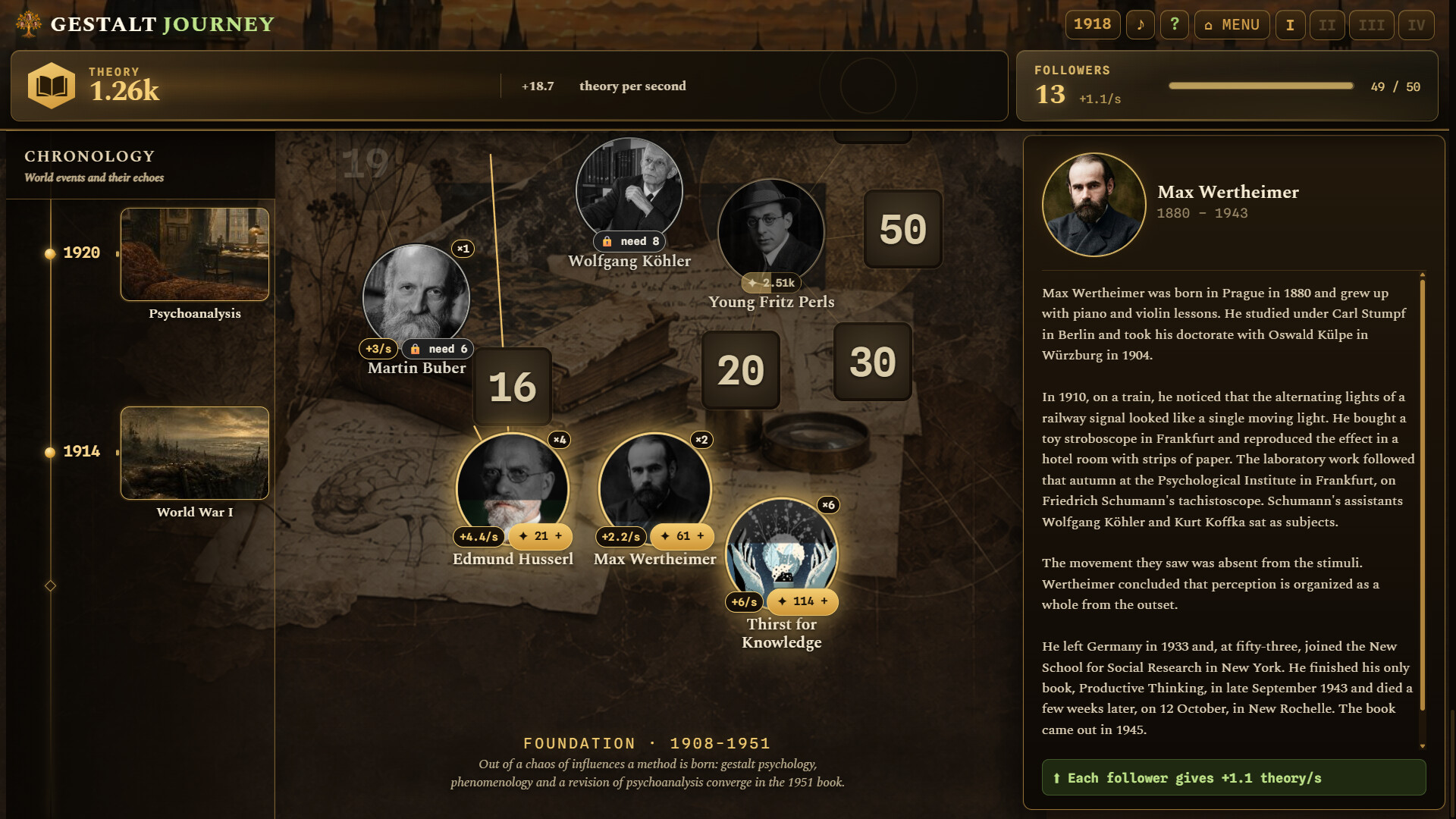
Most clickers let you accumulate something comfortably ridiculous: cookies, gold, enough industrial capacity to make the sun nervous. Gestalt Journey offers professional associations. Somewhere between developing a therapeutic concept and establishing a research tradition, the familiar business of making numbers increase becomes the history of psychotherapy.
I find that a much better opening proposition than another mine full of upgradeable pickaxes. Whether a scholarly journal makes a satisfying purchase is the question that follows.
Released Nov 14, 2026, Gestalt Journey arrives at this November 15 spotlight just one day into its launch. Developer and publisher Oleksii Vynohradov lists it for windows at $6.99, under Casual, Indie. The official pitch calls it an incremental game, explicitly a clicker, about growing Gestalt therapy from a handful of curious people in 1908 into an international movement by 2025.
That is an unusually specific stretch of history to put behind a resource-allocation loop. The specificity is its strongest reason to exist.
Finally, an upgrade tree with professional journals
The joke is not that psychotherapy is silly. It is that the clicker format makes almost any human endeavour look faintly absurd when you turn its development into an accumulation problem. Gather followers. Develop concepts. Write books. Found associations. Congratulations: your intellectual movement now has administrative needs.
Gestalt Journey makes the machinery around a school of thought part of the attraction, rather than treating history as a sequence of famous faces waiting to be collected.
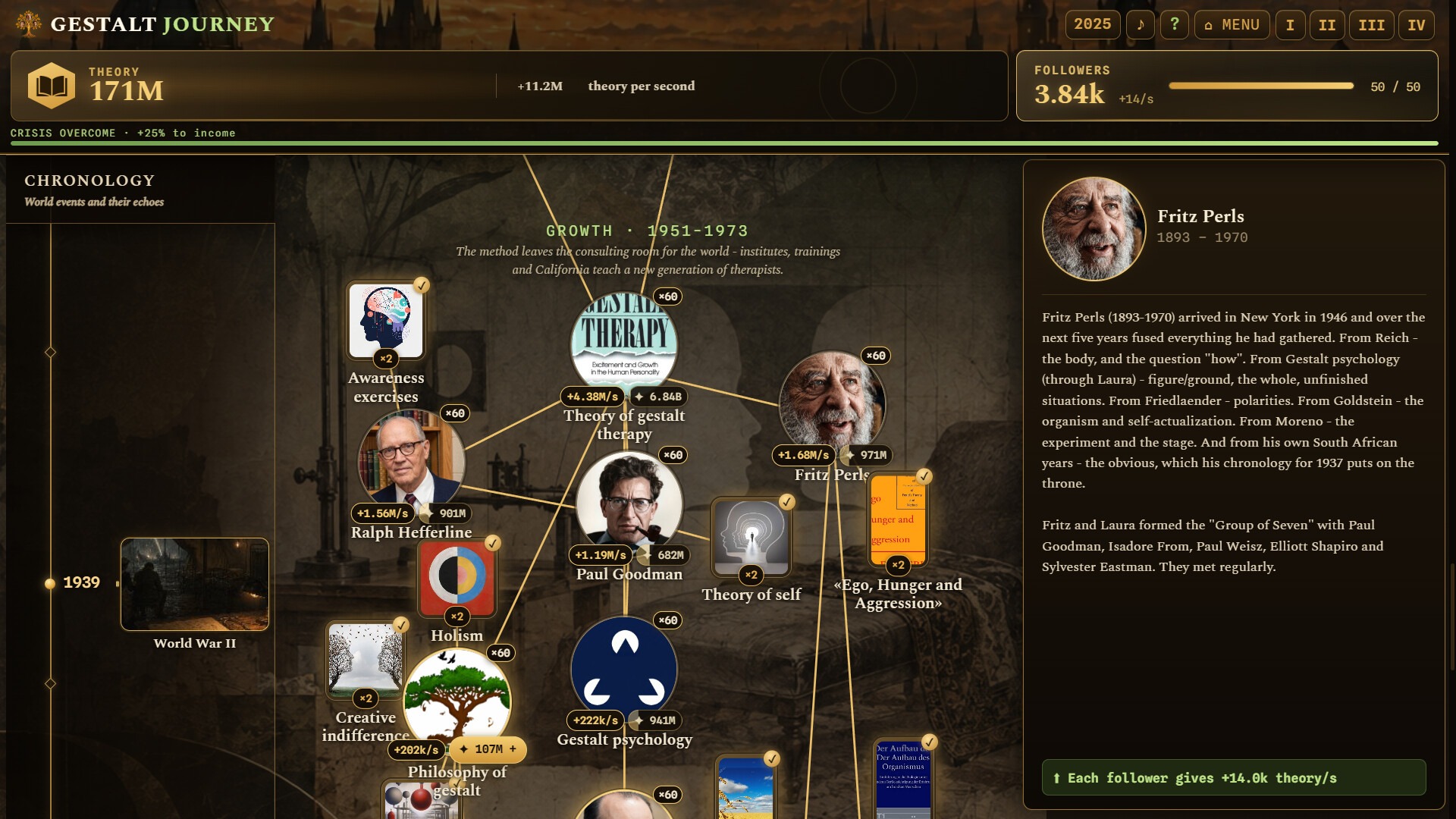
Its stated historical scope includes real therapists, theories, books and organisations. The listing promises a true story behind every card, which suggests that the cards have a second job beyond marking progress: giving the things you accumulate an identity. A book is a particular book; an organisation belongs to an actual history. That distinction matters.
If the historical material earns your attention, an upgrade can become something you want to understand rather than merely afford.
There is a useful comparison with Cookie Clicker here. Both pitches involve growth and decisions about where resources should go. What Gestalt Journey changes is the object of that growth: a documented therapeutic movement instead of an escalating biscuit economy. That does not automatically make it a better clicker.
It gives the repetitive act of expansion a different possible reward, though: reaching a person, publication or institution whose significance extends beyond the next number.
Spend your resources; acquire an intellectual movement
The supported description of the immediate loop is straightforward: things keep growing while you decide where to put your resources. Within that structure, the listing names developing therapeutic concepts, gathering followers, bringing historical therapists into the movement, writing books and founding associations. Those are the activities to expect.
It does not explain the interface cadence, individual resource types or the cost relationships between those activities, so an elaborate account of an opening strategy would be fiction.
What interests me is the potential tension between those destinations for your resources. A movement needs ideas, people and institutions; a resource game needs choices that compete for your attention. Putting those two structures together is a sensible design premise. Whether the actual choices are difficult, legible or satisfying is something the listing cannot establish.
The appeal is clear enough without pretending that a description proves the balancing works.
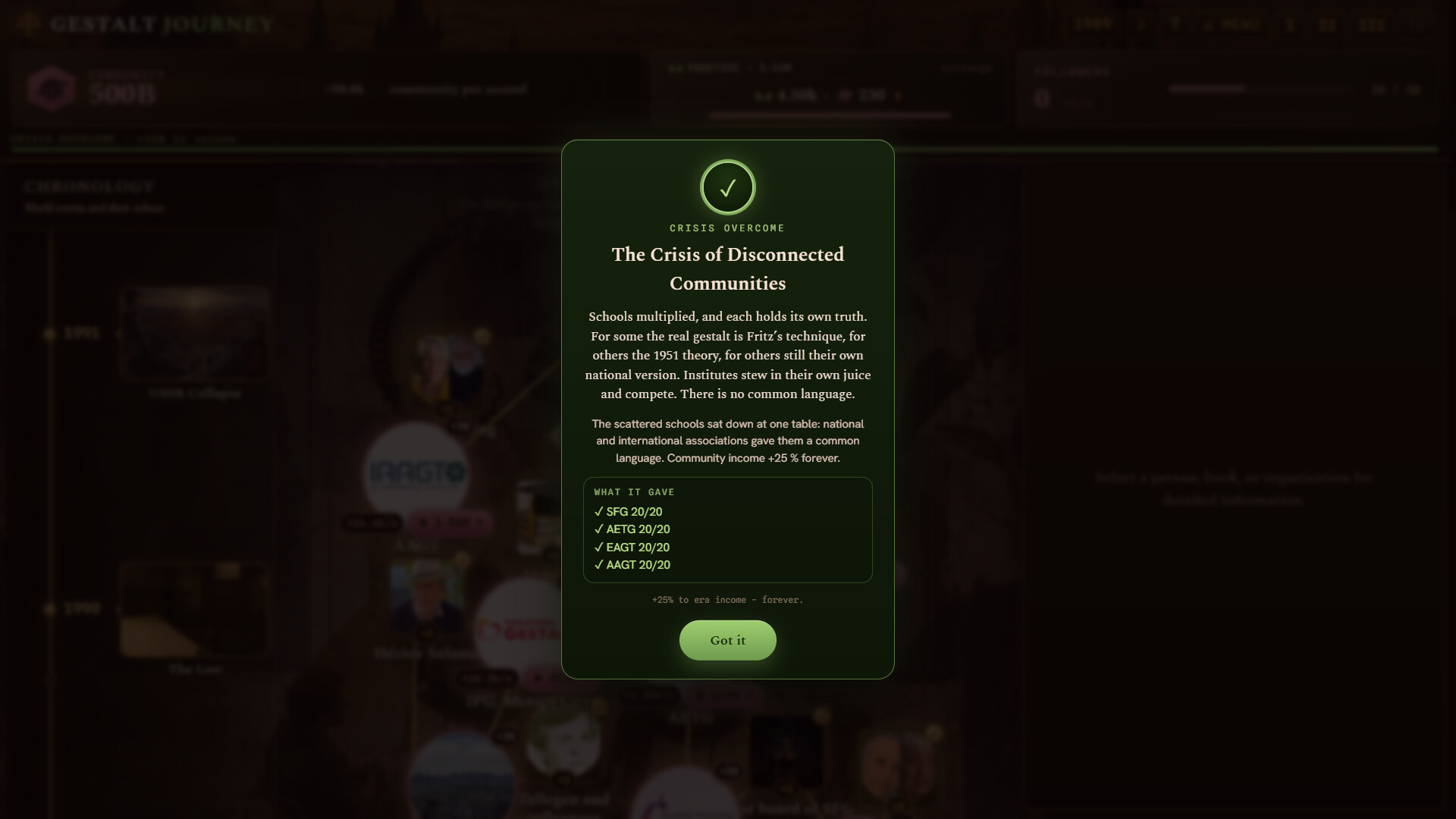
The historical arc also includes difficult periods and crises in psychotherapy's growth. That gives the pitch a complication beyond uninterrupted expansion, but the official text does not specify how those crises operate. They might be central decisions or relatively light interruptions; there is no basis here to decide.
I would go in expecting a clicker with historical material, rather than assuming the depth of an institutional strategy game simply because the subject could support one.
A century is a setting, not a playtime estimate
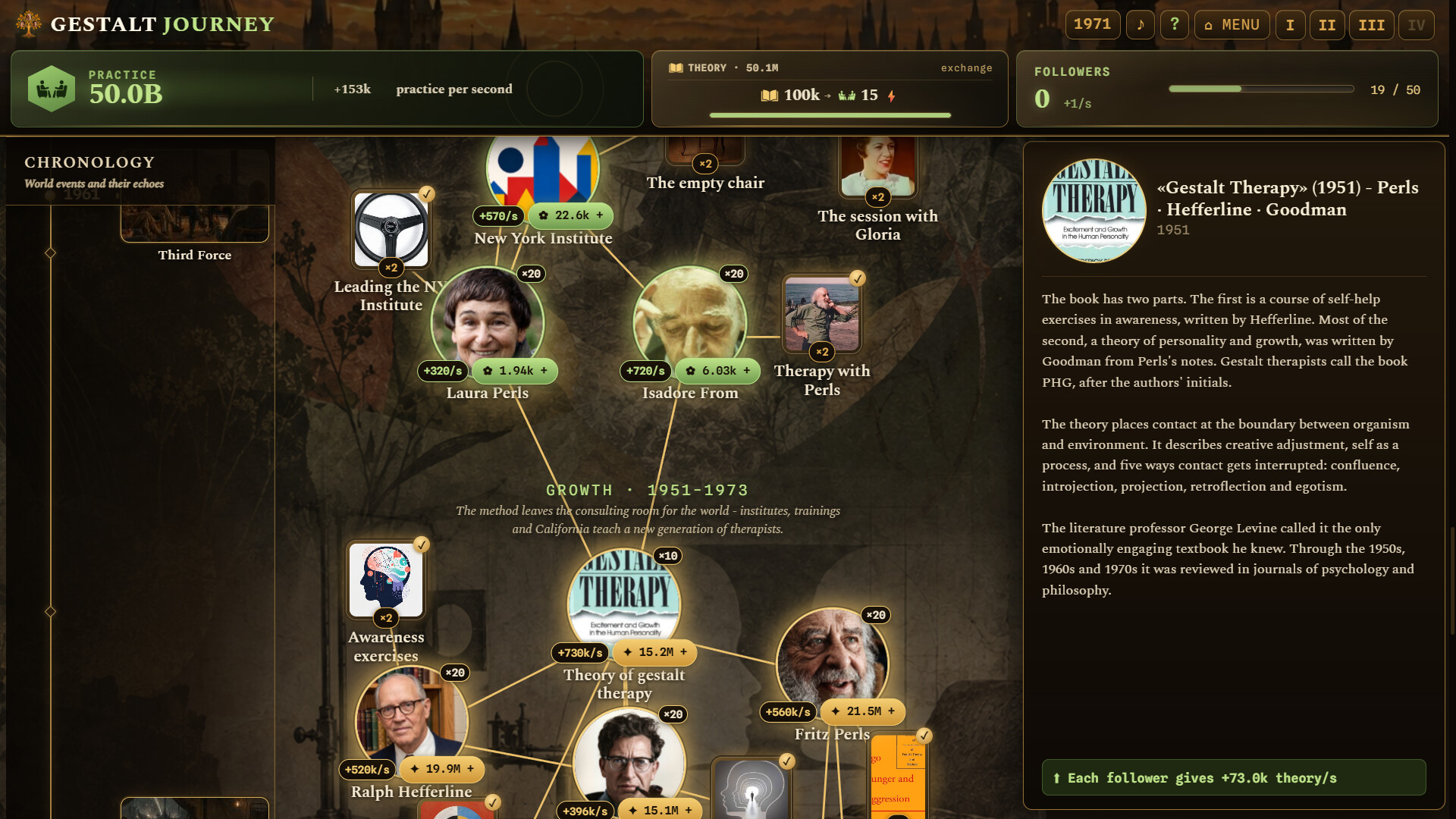
The journey runs from 1908 to 2025, ending with institutes on five continents, professional journals and a research tradition. That is a substantial span for a historical subject. It is not evidence of a substantial number of hours. No playtime estimate, card count or detailed account of replayability accompanies the supplied listing, and $6.99 should be weighed against that uncertainty rather than an imaginary evening count.
Progression is described as building the school from nothing and spreading it across the world. There is no supplied explanation of resets, prestige systems, separate runs or an endgame. Readers who choose incremental games for carefully layered reset economies should pause there.
Gestalt Journey may offer an appealing historical progression, but the available facts do not establish the kind of repeatable optimisation structure that can keep an incremental game compelling after its first major milestones.
Papers, Please is a useful thematic reference with a firm mechanical boundary. That game makes an institution tangible through repeated work; Gestalt Journey proposes making the development of an institution tangible through accumulation and allocation. There is no reason to expect document inspection, its particular moral pressures or its daily structure here.
The connection is the possibility that a routine action can help explain a larger system. Gestalt Journey has to make that argument through growth.
Yesterday's release, today's very small audience
The honest reason to cover Gestalt Journey now is its Nov 14, 2026 release and its peculiar combination of clicker mechanics with psychotherapy history. The supplied current-player figure is 0. That is a snapshot of nobody playing at the measured moment, not a lifetime sales total or a verdict on quality. It certainly does not support a story about a breakout hit.
This is a newly released curiosity getting an editorial look before there is evidence of a crowd.
There are also no supplied player quotes, total review count or review score. No discount is specified. I cannot tell you that early players admire its historical accuracy, complain about its pacing or have found a devastatingly efficient association-building strategy. There is no testimony here to quote.
The case for attention rests on the premise and timing, with the price known and the reception still unestablished in the available information.
That distinction makes this a more useful recommendation, not a less enthusiastic one. A game can deserve a feature because it chooses a subject almost nobody would expect to find in this format. Gestalt Journey puts the history of one therapeutic school at the centre of a growth game, including its books and organisations rather than just its recognisable people. That is enough to make me curious.
Zero current players means curiosity is what I can offer, not social proof.
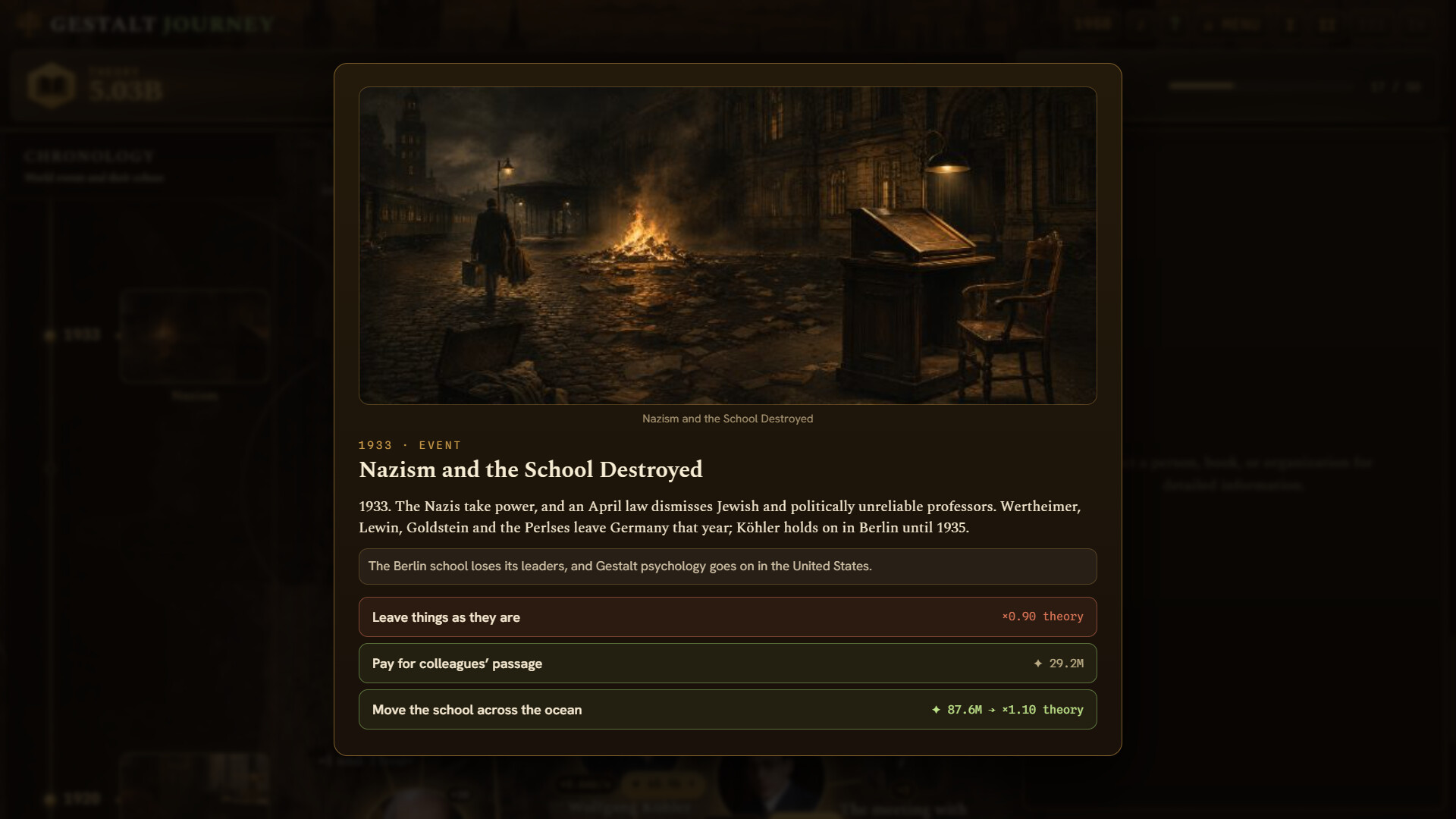
Bring curiosity about therapy, and tolerance for clicking
The natural audience is the reader who already likes incremental games and would enjoy discovering why a particular therapist, theory or organisation belongs in the sequence. The history gives the resource spending a subject; the resource spending gives the history a forward motion. If that pairing appeals, $6.99 buys entry to a much more distinctive premise than the genre labels Casual, Indie manage to convey.
Co-op should not be part of the buying argument: the supplied information describes growing your own school but does not establish multiplayer support or even provide a formal mode listing. Think about the described activity—your decisions about resources and expansion—without assuming shared management, competitive schools or a social layer. Likewise, windows is the only supplied platform.
There is no supported promise here for another operating system or a handheld compatibility status.
My strongest reservation is the possibility that historical complexity becomes indistinguishable from successful accumulation. More followers, more books and more institutes can show how a movement spreads; they cannot, by themselves, explain the value of its ideas or the disagreements around them. The promised stories behind the cards could provide that missing texture.
The listing gives a reason to hope for it, but not enough evidence to certify it. Treat this as a game offering historical learning, not as proof of therapeutic effectiveness.
Skip it if you need demonstrated replay value, established player reception or a detailed strategy system before spending money. Consider it if the words “incremental history of Gestalt therapy” produce an immediate, slightly incredulous interest.
A day after launch, Gestalt Journey's best advertisement is still the thing it has chosen to simulate: the slow conversion of curiosity into concepts, followers, books and organisations. I want more small games willing to make that sort of specific bet. This one asks $6.99 to see whether the bet works.