A Place for Every Potion Demo Makes Finite Cleanup Its Progress Bar
A Place for Every Potion released a public Steam demo on September 21, ahead of a full game currently listed for October 2026. At 1:33 p.m. Malaysia time on September 22, Steam’s official endpoint showed 7 people currently running the demo and zero public demo reviews. Those numbers are not a breakout signal. The reason to examine the game is the specificity of its design: 4,160 scrambled potions, 52 cabinet sections, two linked sorting problems, and an ending defined by the room becoming orderly.

A Place for Every Potion released a public Steam demo on September 21, ahead of a full game currently listed for October 2026. At 1:33 p.m. Malaysia time on September 22, Steam’s official endpoint showed 7 people currently running the demo and zero public demo reviews. Those numbers are not a breakout signal. The reason to examine the game is the specificity of its design: 4,160 scrambled potions, 52 cabinet sections, two linked sorting problems, and an ending defined by the room becoming orderly.
This is a demo preview and market watch based on official materials, not a hands-on review. The developer’s counts are product specifications, not independently verified completion data. The current-player observation is a moment, not a peak or a wishlist estimate.
Why the demo deserves attention now
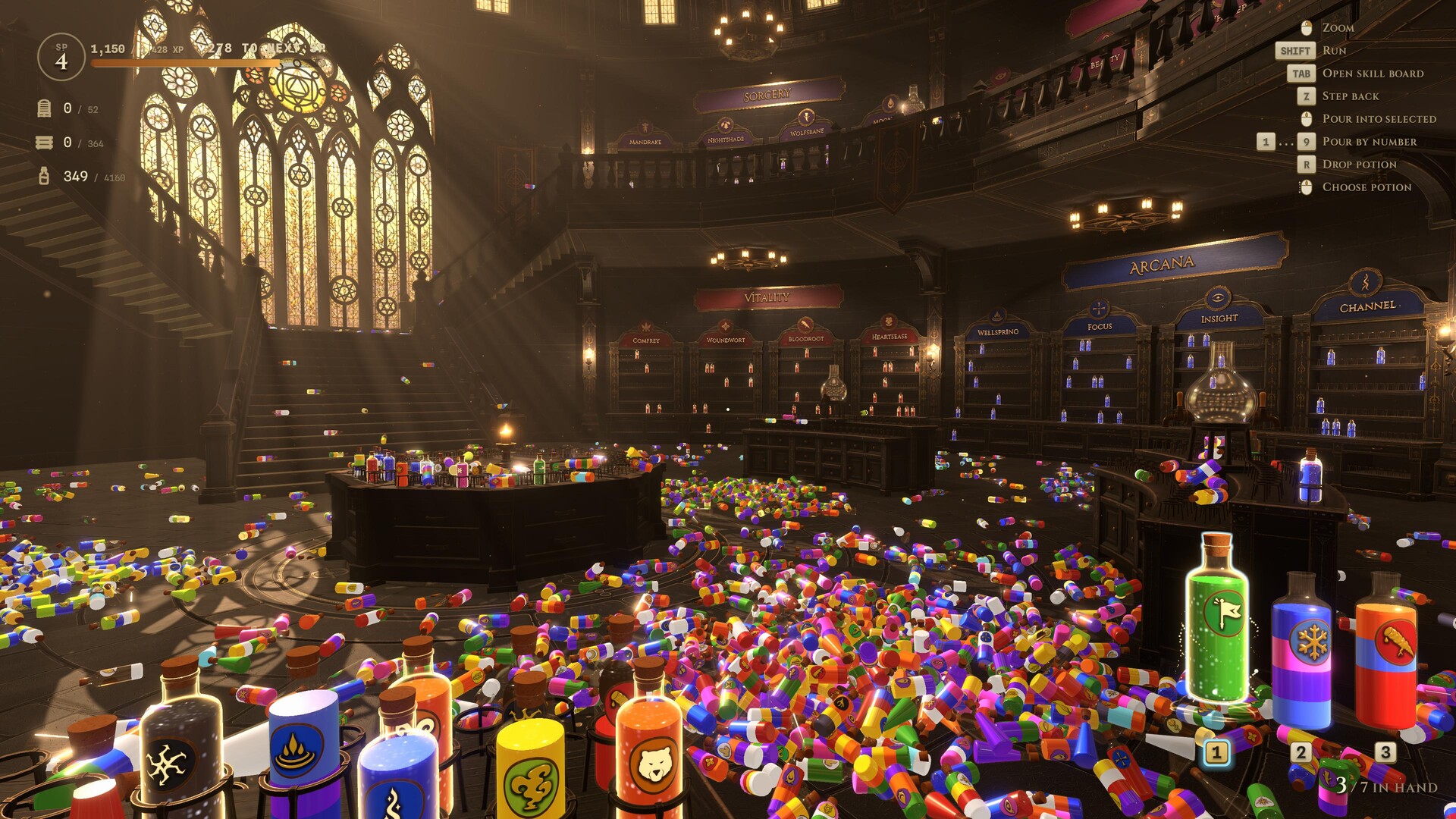
Many cozy organization games sell an endless routine. A Place for Every Potion instead advertises a finite mess. Every potion is present from the start, the pile only gets smaller, and filled shelves become the progress display. That gives repetitive work a visible destination.
The public demo creates the first low-friction chance to test whether that premise feels calming or exhausting. Seven concurrent users are a small discovery signal, but a demo does not need a large population for matchmaking. What matters is whether players finish a meaningful slice, wishlist the full game, and report that the paired puzzles stay readable.
The full game’s official store entry identifies an October 2026 target. Release dates can change, so the live page should be checked again before purchase.
Genre, platform, and release state
Steam classifies the demo as casual, indie, and simulation. It supports Windows and macOS, single-player play, full controller support, input rebinding, save-anytime behavior, and options related to untimed play and volume control. CubeQuad Games is both developer and publisher.
The demo itself is free. The full game is a separate Steam app, and the developer describes it as a buy-once product without ads, energy timers, or an in-game shop. That is an official plan, not a guarantee about future pricing or post-launch changes.
This is a pre-release candidate rather than a finished-game review. There are no public demo reviews to summarize and no basis for claims about late-game pacing, performance across all hardware, or completion time.
The two-part core loop
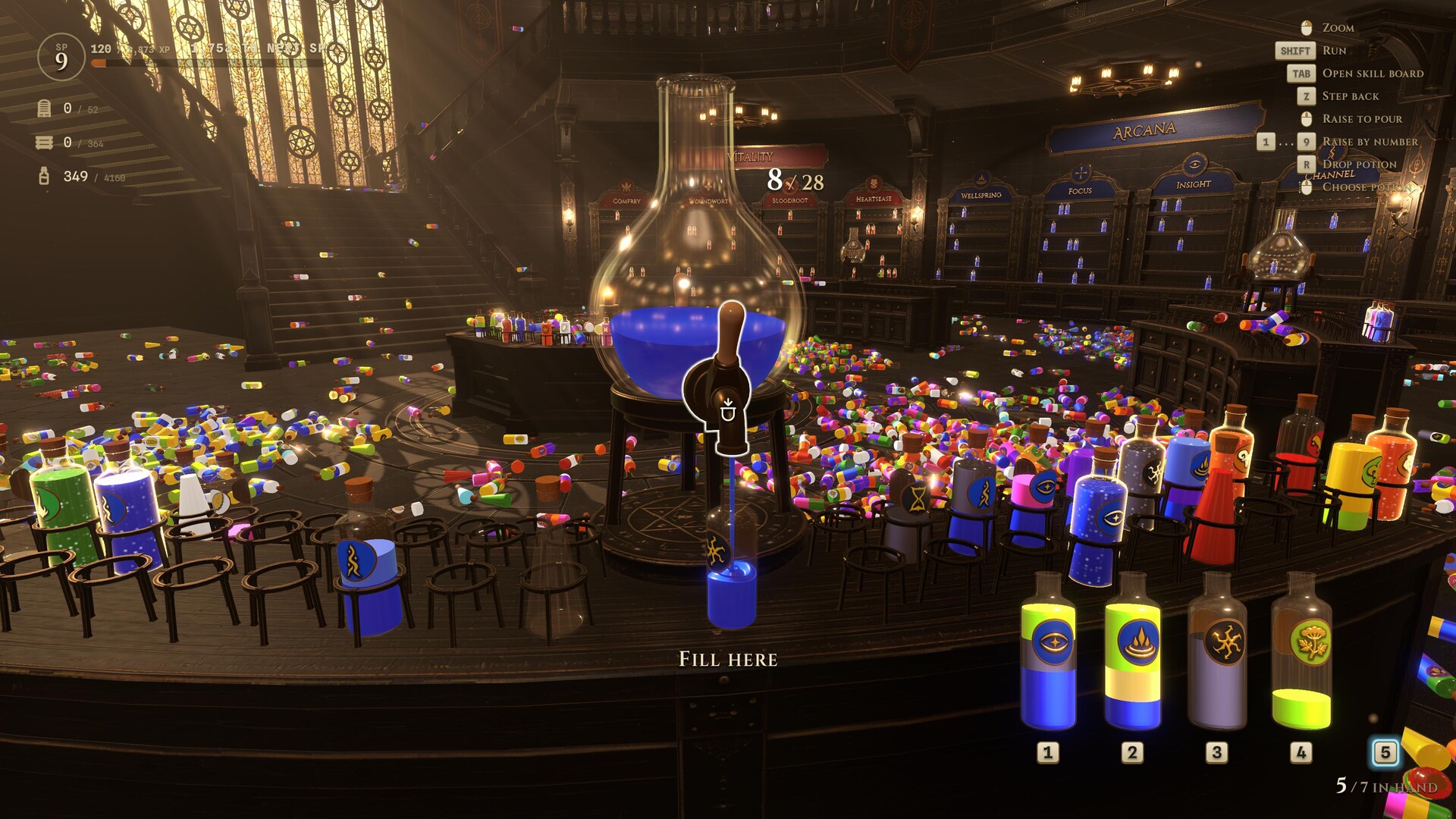
The first puzzle is decanting. Bottles contain mixed colored layers, and the player pours liquid between them until each bottle holds one pure color. This resembles familiar water-sort puzzles, but it is only half the task.
The second puzzle is shelving. A finished potion must be moved across the laboratory to the correct section. Color identifies the broad destination, while the bottle’s sigil identifies the exact shelf. The player can levitate only a limited number of bottles, so carrying capacity is shared between pouring and transport.
That shared constraint is the design’s most promising idea. Using every free slot to solve a color stack can leave no hand available to move finished bottles. Carrying too many completed potions can remove the empty space needed for efficient pours. The two simple systems therefore compete for the same resource.
Progression without automation replacing play
Sorting earns experience, levels, and skill points. The official page describes 47 skill points across 24 nodes, with upgrades such as a wider hand, longer reach, deeper buffers, and an ability to reveal a workable set from the pile.
The stated rule is that upgrades improve the workspace without pouring, carrying, or shelving automatically. That is important because the tactile work is the product. If progression eventually solved the room by itself, the visual cleanup would become passive. If upgrades barely matter, thousands of bottles could feel punitive.
The demo should reveal whether early upgrades improve decision space at a satisfying pace. It cannot prove that all 4,160 potions remain engaging.
Current market signal
The verified snapshot showed:
- 7 current demo players at 1:33 p.m. Malaysia time on September 22;
- zero public reviews for the demo;
- a September 21 demo release;
- an October 2026 target for the full game;
- official Windows and macOS support.
There is no review percentage to report. There is also no public sales figure, and a demo’s player count should not be converted into wishlists or purchases. The only momentum claim supported today is that a small number of people were actively testing it.
What cannot yet be learned from player reaction
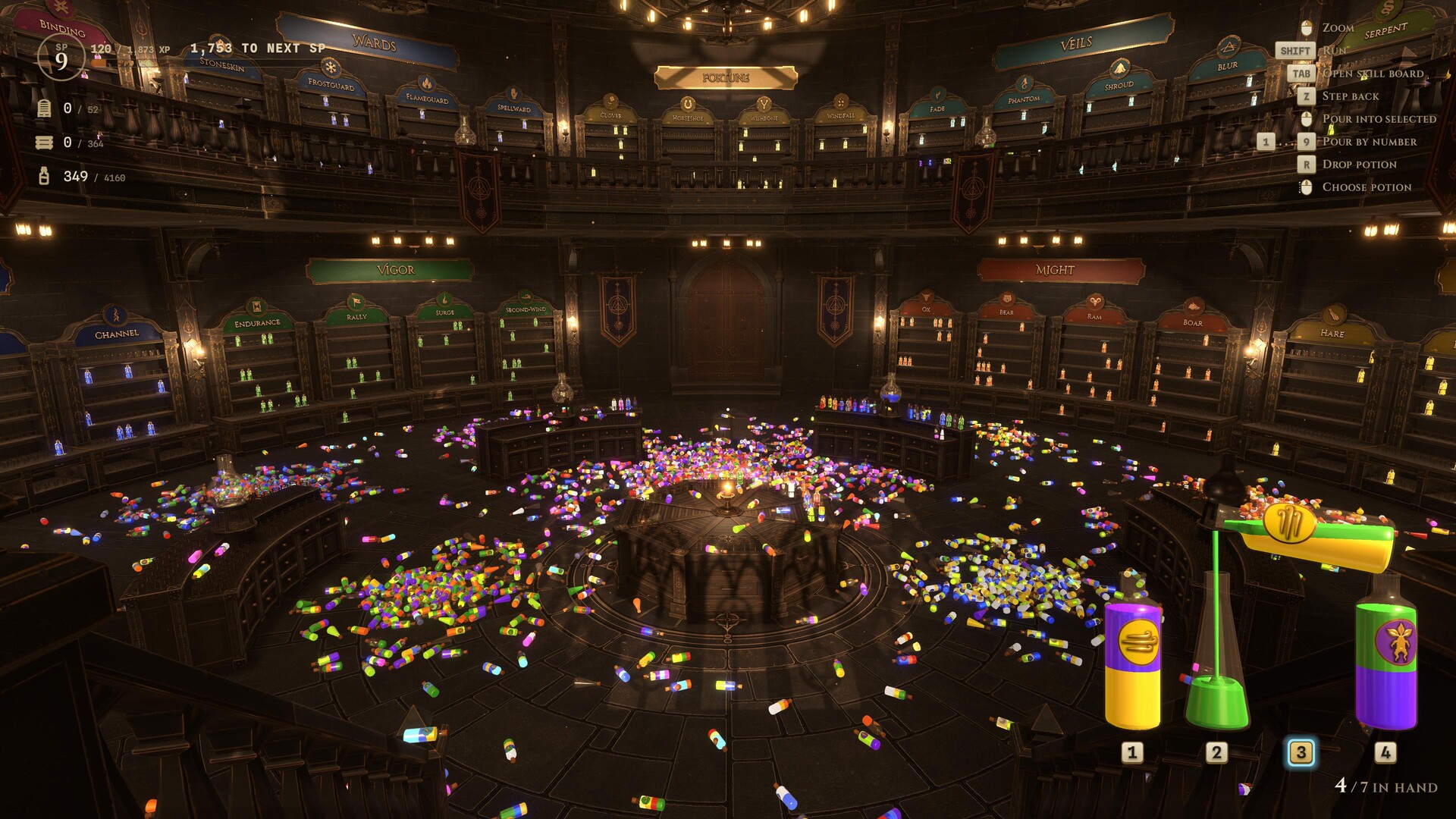
With no public demo reviews, there are no repeated praise or complaint patterns to summarize. Store tags and developer copy describe intention, not reception. Questions for the next evidence check include:
- whether color and sigil distinctions remain accessible at a distance;
- whether carrying thousands of bottles creates unnecessary traversal;
- whether controller selection feels precise around dense shelves;
- whether the skill tree reduces friction without erasing decisions;
- whether autosaves reliably preserve partial pours and placements;
- whether the full game’s finite scope feels satisfying rather than intimidating.
The absence of reviews is not a negative score. It is an evidence gap. Players interested in the premise can use the free demo to answer personal fit questions while avoiding a premature purchase decision.
Competitive meaning
The game sits between water-sort puzzles, tidy-up games, and large-scale job simulations. Water-sort games provide quick abstract puzzles but often reset into endless levels. Tidy-up games provide visual satisfaction but can lack a meaningful optimization problem. A Place for Every Potion tries to connect both: decanting creates a local logic puzzle, while shelving converts solved bottles into permanent environmental progress.
Its strongest competitive idea is the room as a progress bar. The laboratory becomes brighter and more ordered because of completed work, while three counters track sections, rows, and individual potions. This is more tangible than a percentage hidden in a menu.
The risk is arithmetic fatigue. A specific count can make scope honest, but 4,160 repetitions may frighten players who want a weekend puzzle. The no-timer, no-fail design reduces pressure; it does not automatically create variety.
Who should try the demo
The demo is a sensible test for players who enjoy water-sort logic, visible cleanup, long-form completion projects, and games that preserve progress after short sessions. Full controller support and save-anytime design strengthen the case for relaxed play.
Players seeking story, character interaction, or rapidly changing mechanics should wait for fuller coverage. Color-vision and motor-accessibility needs should be tested directly because official feature flags do not prove every puzzle distinction is comfortable.
Editorial verdict
A Place for Every Potion has the weakest raw audience signal of today’s three selections but the clearest pre-release design thesis. It connects two ordinary puzzles through a shared carrying constraint and turns a finite environment into visible progress.
Verdict: a worthwhile demo preview, with market momentum still unproven. The public test is exactly the right next step for this concept. The full game will need pacing, accessibility, and upgrade variety strong enough to justify its deliberately enormous bottle count.
Sources and image rights
- Official demo store and media page, checked September 22, 2026: https://store.steampowered.com/app/5247530/
- Official full-game page, checked September 22, 2026: https://store.steampowered.com/app/5189500/
- Steam public review endpoint, checked September 22, 2026: https://store.steampowered.com/appreviews/5247530?json=1&language=all&purchase_type=all
- Steam current-player endpoint, checked September 22, 2026: https://api.steampowered.com/ISteamUserStats/GetNumberOfCurrentPlayers/v1/?appid=5247530
- Images: official Steam capsule and screenshots supplied by CubeQuad Games, © CubeQuad Games. Downloaded locally on September 22, 2026 and used without compositing in the minimum scope needed to identify and analyze the game.