Vampire Crawlers Proves the Survivors Formula Can Become a Card Combo Machine
Vampire Crawlers: The Turbo Wildcard from Vampire Survivors is not a September launch, but its first 20% Steam discount made it newly visible in the latest market report. At approximately 12:05 a.m. Malaysia time on September 10, Steam showed 1,350 current players and 18,983 all-language reviews, including 18,255 positive and 728 negative recommendations. That is an extraordinary 96.2% positive share.

Vampire Crawlers: The Turbo Wildcard from Vampire Survivors is not a September launch, but its first 20% Steam discount made it newly visible in the latest market report. At approximately 12:05 a.m. Malaysia time on September 10, Steam showed 1,350 current players and 18,983 all-language reviews, including 18,255 positive and 728 negative recommendations. That is an extraordinary 96.2% positive share.
The U.S. store listed the game at $9.99, discounted to $7.99, with Windows and macOS support. The review pool is large enough to make this more than a niche curiosity, although the Vampire Survivors name gives it an audience advantage that a new card game cannot copy. This article analyzes market and review signals from public sources; it is not a hands-on review.
Why it is visible now
The September 5 report highlighted the first discount and an observed 837 current players with a 1,123-player 24-hour high. Our later snapshot was higher at 1,350. Time-zone variation and sale traffic prevent a direct retention conclusion, but the discount clearly gives the game another discovery moment months after its April release.
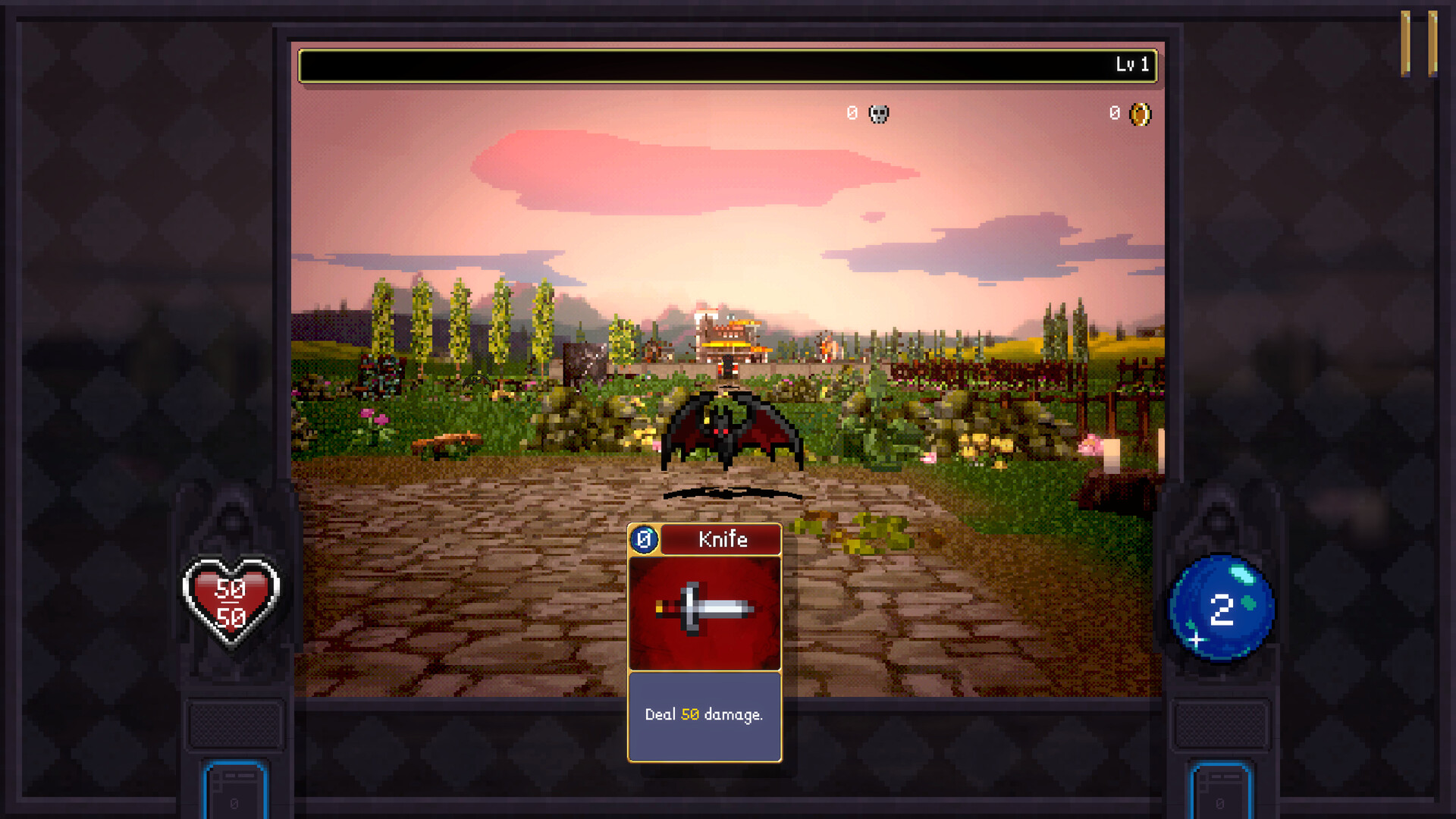
The title matters because it translates the “numbers become absurd” pleasure of Vampire Survivors into a different input language. Instead of steering through crowds while weapons fire automatically, players explore from a first-person view and assemble card sequences that produce escalating effects.
That is a more meaningful adaptation than placing familiar characters on a conventional deckbuilder. The designers preserved the franchise's emotional result—rapid, legible power growth—while changing the moment-to-moment mechanics.
Genre, platform, and release status
Steam lists Vampire Crawlers as Action, Indie, and Strategy. It is a fully released single-player title from poncle and Nosebleed Interactive, published by poncle. Windows and macOS are supported; Linux is not listed in the current store data.
The game combines first-person dungeon navigation, roguelite structure, deck construction, and combo ordering. Its most obvious competitors include Slay the Spire and other card roguelites, first-person dungeon crawlers, and the expanding family of Vampire Survivors spin-offs.
The comparison needs care. A recognizable franchise can generate reviews, store visibility, and a lower acquisition cost. The design still has to satisfy those buyers. A 96.2% positive share across nearly 19,000 reviews suggests that familiarity did not merely produce curiosity; most reviewers recommend the result.
The loop: explore, order cards, break the curve
Players move through dungeons, encounter enemies and choices, acquire cards, and arrange effects around mana costs and combo rules. The important decision is not only which card enters the deck but when it fires relative to the rest of the sequence.
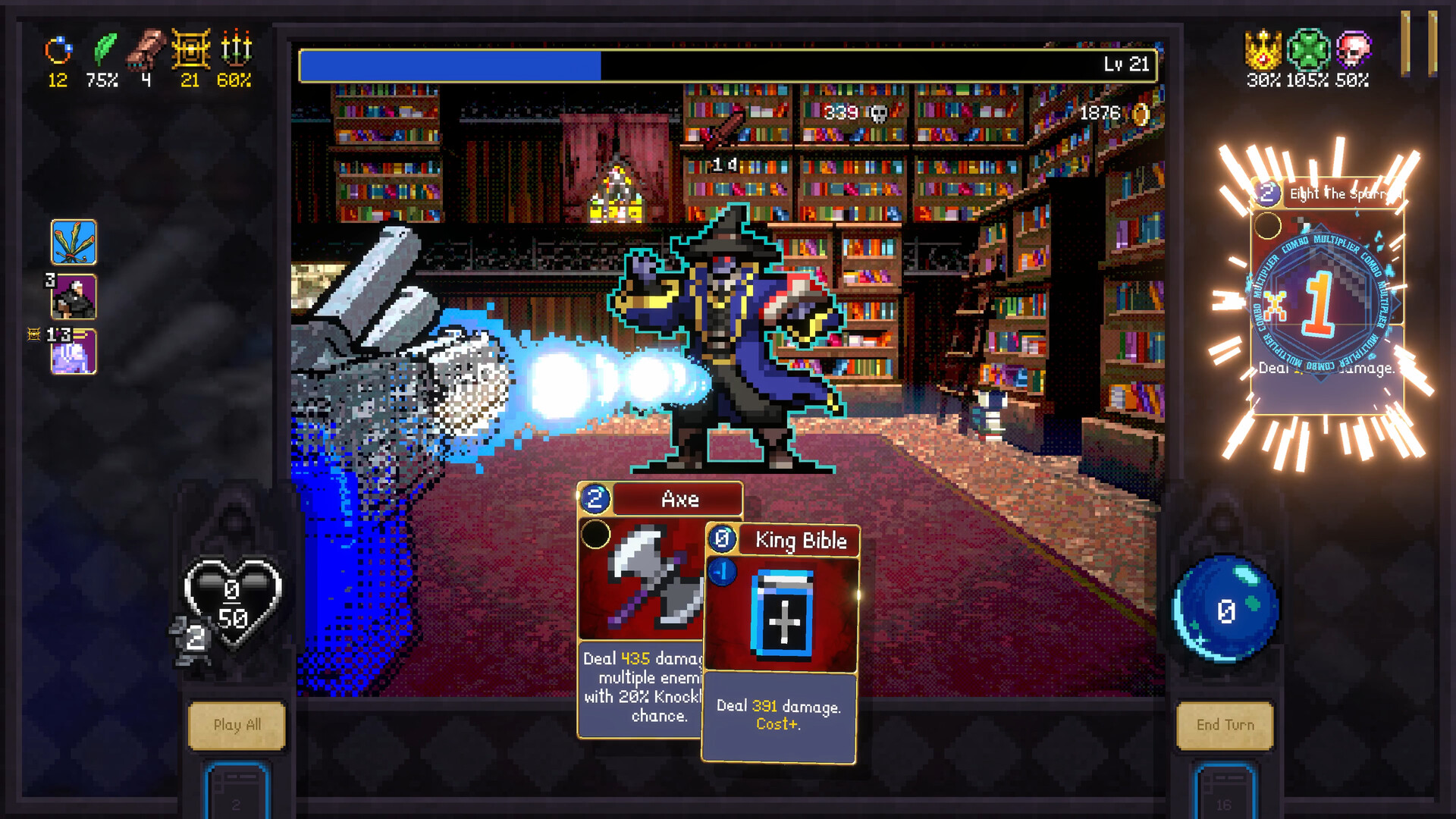
As the deck improves, card draw, mana generation, damage multiplication, and triggered effects can create long chains. Permanent unlocks support later runs. The result tries to recreate the accelerating spectacle of Vampire Survivors through planning: the player engineers an engine, then watches the engine produce far more than its individual parts imply.
First-person presentation keeps the dungeon spatial. Card games can become detached tables of icons; here, rooms, enemies, treasure, and movement retain a sense of place. Strong audio and interface feedback make each trigger readable even when the chain becomes dense.
The central risk is convergence. If the best runs always depend on card draw plus mana generation, apparent variety can collapse into one dominant engine. Several negative or qualified reviews raise that concern.
Market numbers and price context
The verified public snapshot was:
- 1,350 current Steam players;
- 18,983 all-language reviews;
- 18,255 positive and 728 negative recommendations;
- 96.2% positive after rounding, shown as Overwhelmingly Positive;
- $9.99 U.S. list price, discounted 20% to $7.99.
Steam does not publish copies sold, net revenue, refund rate, or the share attributable to the discount. Review count cannot be converted to unit sales with a universal multiplier. The numbers do establish a large feedback sample and a healthy active audience several months after release.
We inspected the first 20 recent all-language reviews returned by Steam. Eighteen were positive and two negative. The sample is bounded, self-selected, and multilingual, so it is used to identify themes rather than estimate a separate score.
What players praise and criticize
Positive reviews repeatedly describe the game as immediately satisfying, inexpensive, comfortable on handheld play, and capable of producing the same “one more run” pull as the original franchise. Players praise the interface, audio-visual feedback, combo spectacle, simple entry, and the feeling that carefully ordered cards can explode into excessive power.
The enthusiasm is unusually consistent across languages. Many reviewers identify the Vampire Survivors lineage as a benefit, but others say the card system surprised them despite not normally preferring deckbuilders. That suggests the feedback and progression soften the genre's usual learning barrier.
Negative feedback in the recent sample is limited but coherent. One complaint argues that mid-campaign strategy converges on card draw and mana generation, reducing meaningful deck variety. Another says the spin-off lacks the original game's magic. Qualified positive comments similarly note that a broken engine can become repetitive.
The large aggregate does not erase those design risks. It indicates that most players find the payoff worth them.
Meaning beside its competitors
Traditional deckbuilders emphasize uncertainty, resource conservation, and precise tactical exchanges. Vampire Crawlers prioritizes acceleration and spectacle. Its design asks how quickly a build can become delightfully unreasonable, then uses dungeon progression to space out that escalation.
Compared with Vampire Survivors, direct card sequencing adds more deliberate construction. Compared with Slay the Spire, combat appears less concerned with austere efficiency and more with chain reactions. The franchise identity gives the game permission to value excess.
The transferable lesson is not to copy garlic icons or mana ladders. It is to identify the emotional contract of an existing game and rebuild that contract through a different mechanic. Poncle could change camera, genre, and controls because the promise of explosive growth remained recognizable.
Who should buy—and the caution
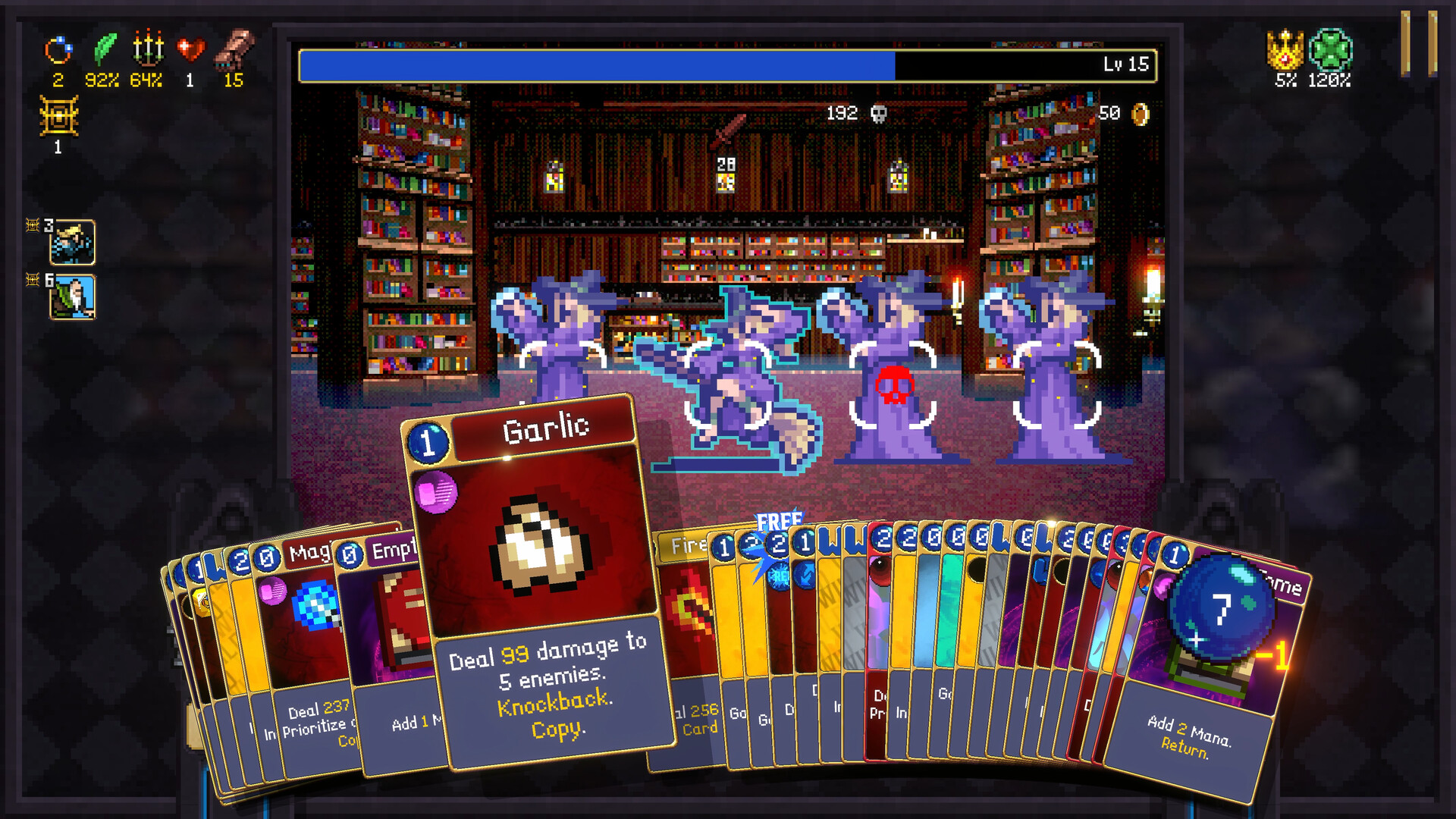
Vampire Crawlers is a strong fit for players who enjoy card engines, short roguelite sessions, escalating audiovisual feedback, and the Vampire Survivors sense of excess. The $7.99 sale price lowers the risk for curious players who normally find deckbuilders too dry.
Wait if dominant strategies ruin experimentation for you, if first-person dungeon movement is uncomfortable, or if you want the exact passive-action loop of Vampire Survivors. This is a related design, not a replacement for the original.
IndieGame.party verdict
The review signal is exceptionally strong: 18,983 reviews with 96.2% positive sentiment and 1,350 players at a late-night regional snapshot. Existing IP helped visibility, but it cannot manufacture nearly 19,000 recommendations by itself.
Our verdict is strongly recommended for combo-minded roguelite players. The caution is long-run variety, not basic quality. Vampire Crawlers succeeds because it preserves the emotional curve of its parent game while giving players a new machine to build.
Data and image sources
- Official Steam store page: https://store.steampowered.com/app/3265700/Vampire_Crawlers_The_Turbo_Wildcard_from_Vampire_Survivors/
- Steam public review-summary and current-player endpoints, checked September 10, 2026 at approximately 12:05 a.m. MYT.
- Review themes summarize a bounded sample of 20 recent all-language public reviews; individual wording was not reproduced.
- All four images are official Steam store assets supplied by poncle, downloaded locally on September 10, 2026 for identification, reporting, and criticism. They are not composited or materially altered.