The Crust 1.0 Turns a Lunar Factory Into a Test of Save Stability
The Crust left early access on September 10 with one of the strongest premises in automation games: build a lunar industrial base that Earth depends on, link surface and underground production, manage colonists, and trade with competing terrestrial factions. Version 1.0 gives the game a fresh visibility window. It also makes technical reliability more consequential because “full release” changes what buyers reasonably expect.

The Crust left early access on September 10 with one of the strongest premises in automation games: build a lunar industrial base that Earth depends on, link surface and underground production, manage colonists, and trade with competing terrestrial factions. Version 1.0 gives the game a fresh visibility window. It also makes technical reliability more consequential because “full release” changes what buyers reasonably expect.
At 1:03 p.m. Malaysia time on September 14, Steam's official endpoints showed 1,350 concurrent players and 3,962 all-language reviews: 3,039 positive and 923 negative, or 76.7% positive. The morning report had recorded 1,732 players. This is market and review-signal analysis, not a hands-on review.
Why it is visible now
Version 1.0 adds a completed campaign with multiple endings, new maps, planning tools, expanded logistics controls, and other systems aimed at both returning players and newcomers. A major version creates a reason to reassess a game whose review history spans years of early access.
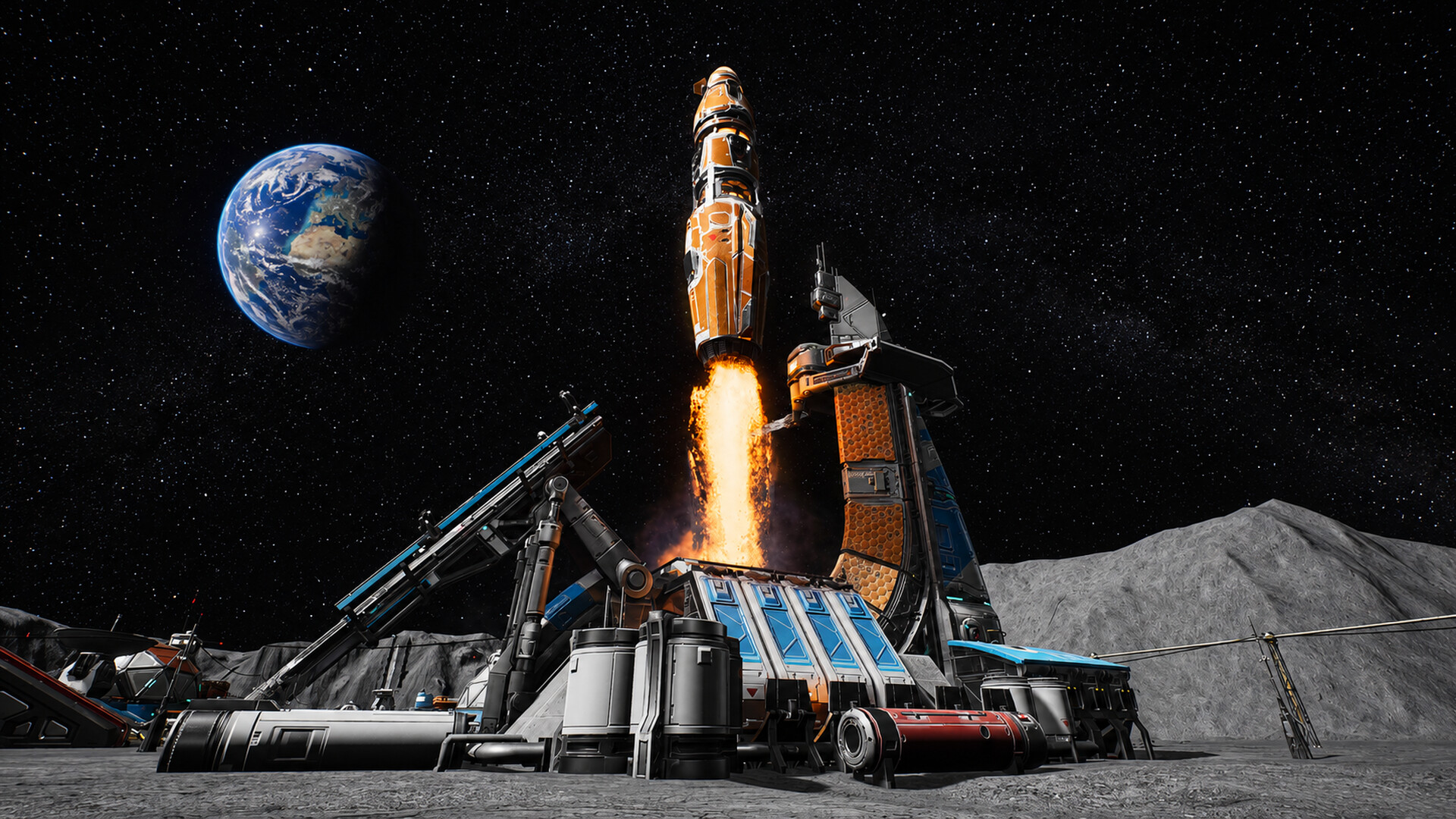
The lunar setting gives ordinary factory operations narrative pressure. Mining regolith is not only resource extraction; it supports a colony and contractual relationships with Earth. Surface solar infrastructure, underground factories, drones, colonists, and faction choices let the same production graph operate at several scales.
Malaysia pricing was RM51.99 during a 35% promotion, down from RM79.99 at the publication check. That is a substantial launch discount, but it does not erase the risk signaled by recent technical complaints.
Genre, platform, and release status
Steam lists The Crust as a released simulation and strategy game for Windows and macOS. The store promises mining, conveyor and drone factories, colonist management, trade, and a story campaign. It is no longer presented as early access.
The current proposition sits between approachable colony management and heavy automation. One recent positive reviewer called it a solid factory simulation with reduced complexity compared with the largest genre leaders. That can be an advantage for players intimidated by Factorio-scale optimization.
Platform labels require nuance. A recent M-series Mac user reported frequent crashes and suspected a Rosetta-based port. One review cannot establish platform-wide failure, but Mac buyers should check current system requirements, patches, and reports from matching hardware before purchasing.
The core loop and 1.0 differentiation
The main loop is mine lunar resources, refine them through connected production chains, route materials with conveyors and drones, build energy and life-support capacity, manage colonists, fulfill contracts or faction goals, research technology, and expand.
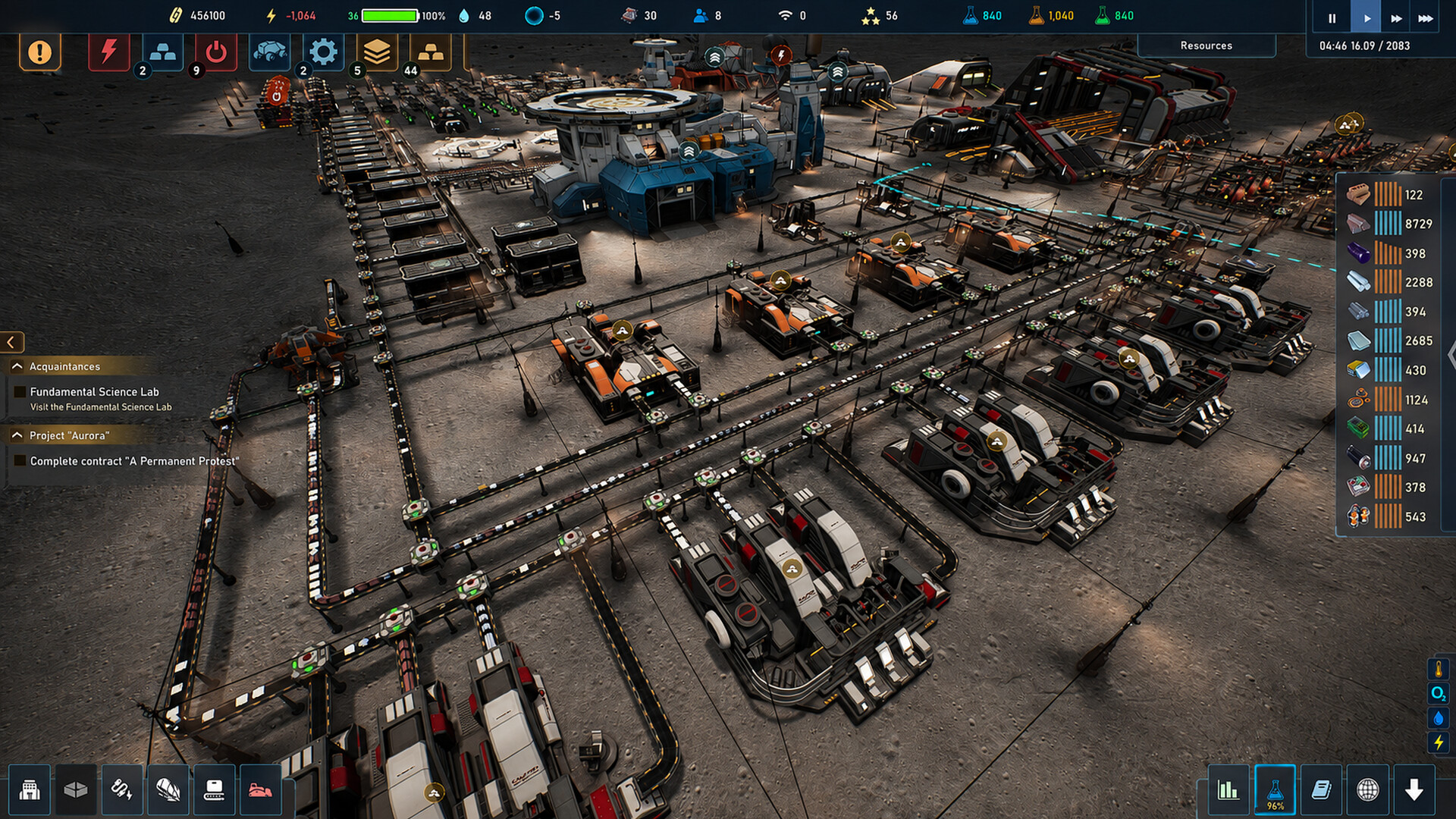
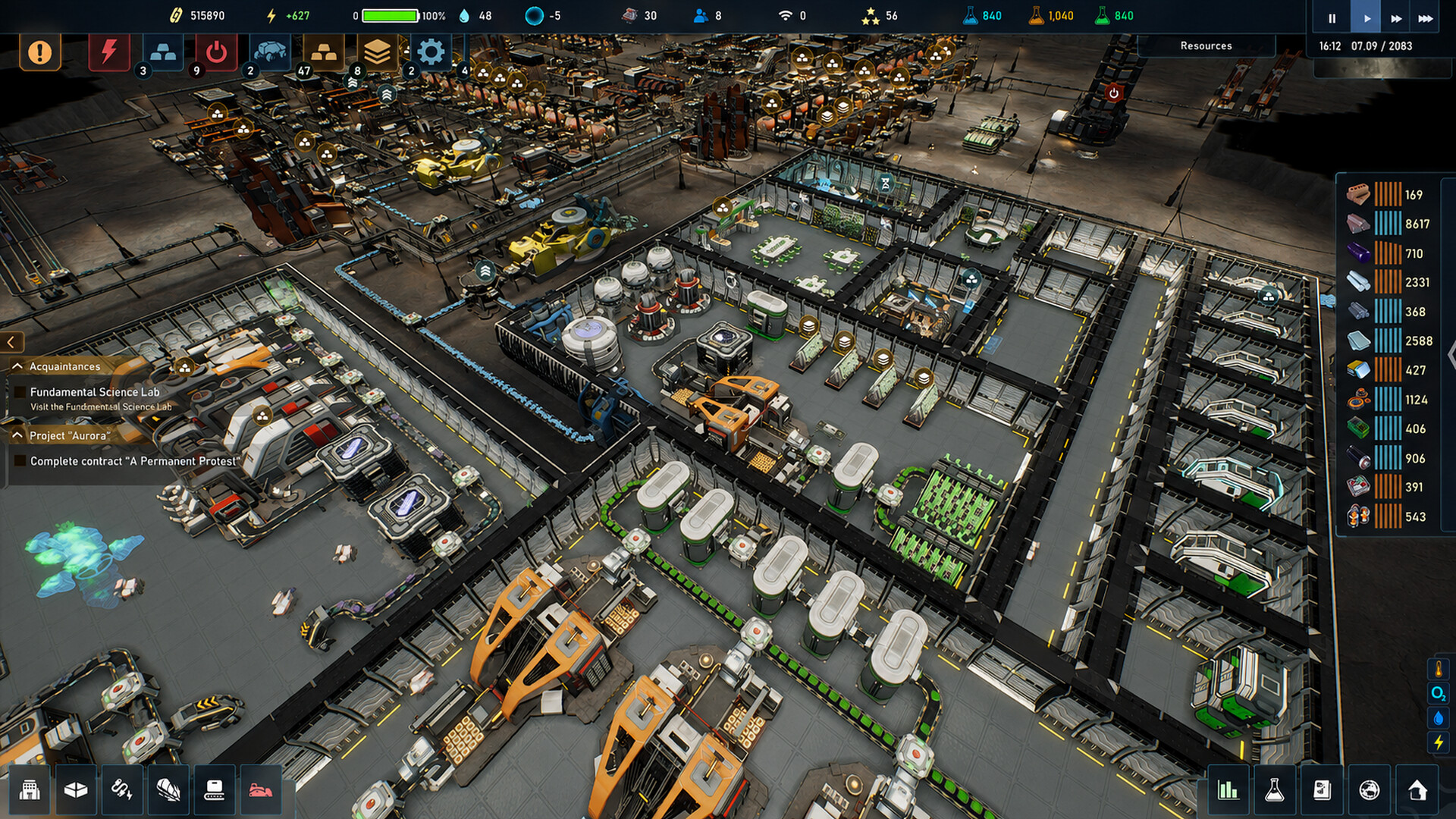
Vertical separation between surface and underground spaces is visually and mechanically distinctive. The player is not decorating one flat factory. They coordinate extraction, storage, transport, power, and habitation across layers with different constraints.
Planning Mode is strategically important because complex factories need safe experimentation. A blueprint or pre-placement layer lets players reason about footprints and flows before spending resources. Logistics designation can reduce manual correction if its interface makes priorities visible.
The campaign provides motivation beyond throughput. Multiple endings and Earth factions can turn a resource target into a political choice. The risk is that scripted objectives collide with a simulation that permits many layouts and research sequences. Recent complaints about unclear objectives and references to unavailable research suggest that this integration still needs work.
Verified market snapshot
The all-language review endpoint returned 3,962 reviews, 76.7% positive. Unlike a brand-new title's score, this pool includes the early-access period. It reflects the project's history, not only four days of version 1.0.
Current players were 1,350 at the publication check, while the morning report recorded 1,732. That is a credible returning audience. It is not evidence of unit sales, revenue, or profitability, and public Steam endpoints do not supply those values.
The large historical review base makes the overall ratio stable but can hide a different recent-release pattern. Buyers should compare recent reviews with the lifetime summary. A 1.0 patch can improve old weaknesses or introduce new ones, and aggregate data moves slowly.
Repeated praise and complaints
Positive reviews praise the lunar theme, soundtrack, visual atmosphere, factory logic, and an approachable version of conveyor-based automation. Some players like the story and the way logistics connect to a colony rather than existing as pure abstraction.
Recent negative reports are more consequential. The 20-review sample included crashes on Apple Silicon, save corruption after long sessions, unreliable autosaves, inaccurate tooltips, unclear or impossible objectives, audio and localization issues, and a general view that the game still behaves like early access.
The save-corruption report came from a user with extensive playtime and described rebuilding a complex section after a crash. That is anecdotal, not proof of a broad defect rate. It is still the kind of failure that automation players should take seriously because a factory represents many hours of accumulated design.
No review sample can determine prevalence. The correct response is not to declare the build broken for everyone, but to look for patch acknowledgements, back up saves where possible, and avoid treating the 1.0 label as sufficient evidence of stability.
Competition and market meaning
The Crust competes with Factorio, Satisfactory, Dyson Sphere Program, Surviving Mars, and Oxygen Not Included. It will not beat each rival on systemic depth. Its opportunity is combining understandable factory logistics with a grounded lunar campaign and colonist stakes.
The current player count suggests that the 1.0 event successfully brought attention back. The review ratio shows a game many people enjoy despite persistent friction. Whether the launch becomes durable depends less on adding another building and more on save reliability, clear objectives, platform stability, and interface truthfulness.
For developers, the lesson is severe: simulation complexity compounds the cost of failure. A crash in a short action game loses minutes. A corrupted factory save can erase a player's authored system. Reliability is therefore part of game design, not only engineering hygiene.
Who should buy and who should wait
Buy now if you want lunar colony fiction, layered automation, and a campaign around production, and if you are comfortable maintaining backup saves while the 1.0 patch cycle continues. The 35% discount and substantial review history reduce some purchase uncertainty.
Wait if save integrity, Apple Silicon support, polished objectives, or mature late-game stability are non-negotiable. Recent reports justify waiting for explicit fixes and a cleaner recent-review trend.
IndieGame.party verdict
The Crust is a credible automation game with a meaningful 1.0 audience and a technical-risk discount attached. The concept and factory loop are strong enough to earn sustained interest. Our verdict is recommended with caution for experienced automation players; wait for stability patches if lost progress would ruin the experience.
Data and image sources
- Official Steam store: https://store.steampowered.com/app/1465470/The_Crust/
- Official 1.0 announcement: https://store.steampowered.com/news/app/1465470/view/693146024068251842
- Steam public review summary: https://store.steampowered.com/appreviews/1465470?json=1&language=all&purchase_type=all
- Steam current-player API: https://api.steampowered.com/ISteamUserStats/GetNumberOfCurrentPlayers/v1/?appid=1465470
- All four images are official Steam store assets, © VEOM Studio and Crytivo, downloaded locally on September 14, 2026 for identification, reporting, and criticism without compositing or semantic alteration.