Stellacore Defense Asks You to Build the Maze, Then Play a Card Game Inside It for $5.94
Slash Studio's new tower defense splits the genre in two: you plan enemy paths by hand, then fight with a deck of tactical chips. It's $5.94, out now, and almost nobody is playing it yet.
<figcaption>Official trailer — Stellacore Defense</figcaption></figure>
The pitch is the punchline
The first thing I noticed about Stellacore Defense is that it has the confidence to call its own strategic depth "unparalleled" in the Steam short description. That's the kind of line that usually precedes a game where you place six identical towers and watch a progress bar.
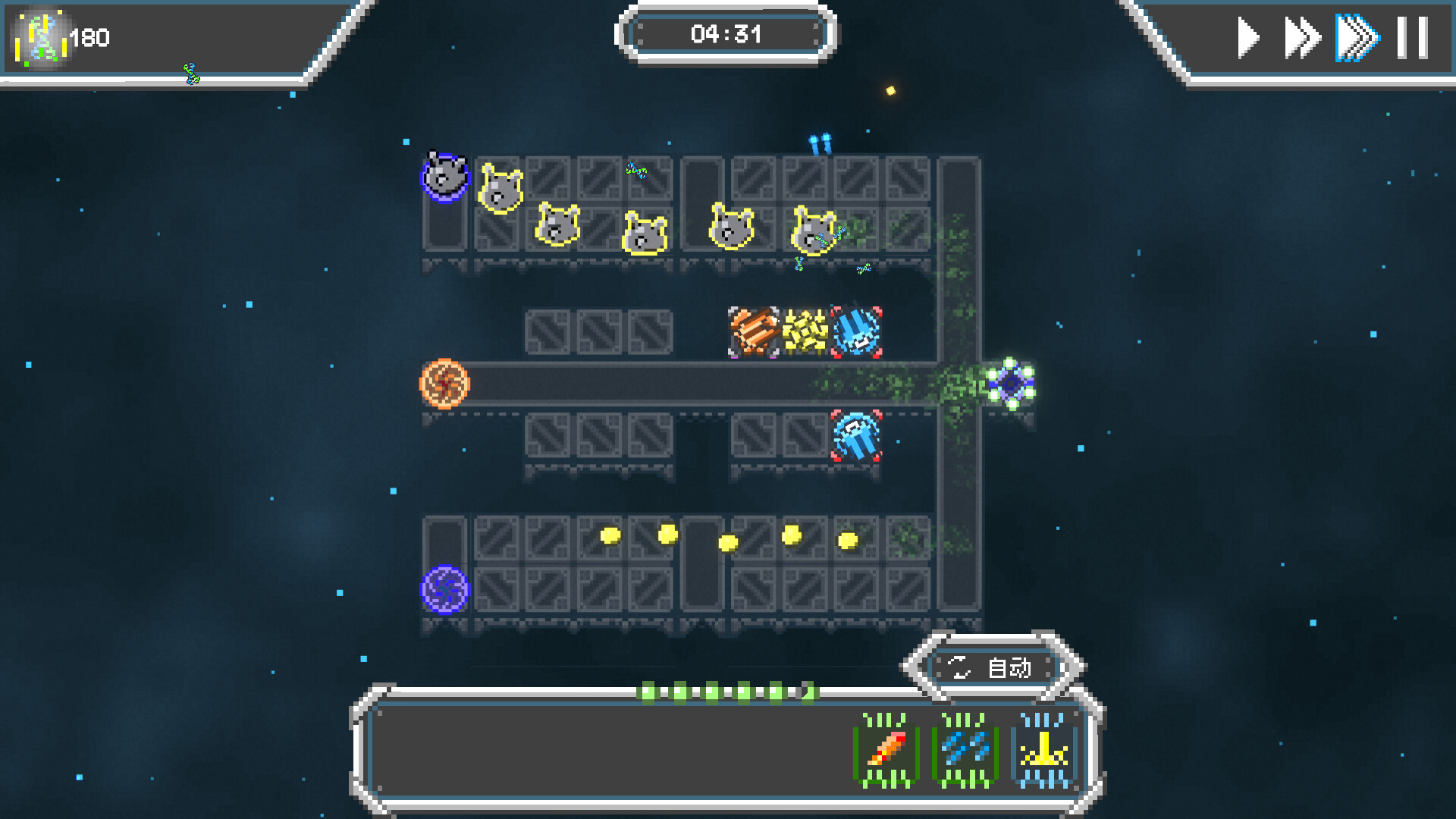
But Slash Studio's $5.94 release, out yesterday on Windows, actually has a mechanical reason to brag: it splits tower defense into two phases that don't talk to each other. You build the maze during Construction, then you can't build anything during Combat. Instead, you fight with a deck of tactical chips generated by the towers you already placed.
It's a design that borrows the path-shaping of Dungeon Defenders and the card-synergy of Balatro, then welds them together with a resource system that punishes you for treating either half casually.
The premise is appropriately apocalyptic: humanity has exhausted its resources, fled through a wormhole, and discovered Stellacore energy, which is apparently the lifeblood of civilization. The space station is run by an AI named Aethis, who wakes you from slumber because dimensional native creatures are stealing the Stellacore.
It's a setup that exists mostly to justify why you're building gun towers in a pixel-art void, and that's fine. The story levels are there, 27 of them, but the real pitch is the two-phase cycle. I keep thinking about how rare it is for a tower defense game to actively forbid you from reacting to a wave with a new tower. That's the entire genre's safety net, and Stellacore Defense yanks it away.

Six modules, three paths, one rule that actually matters
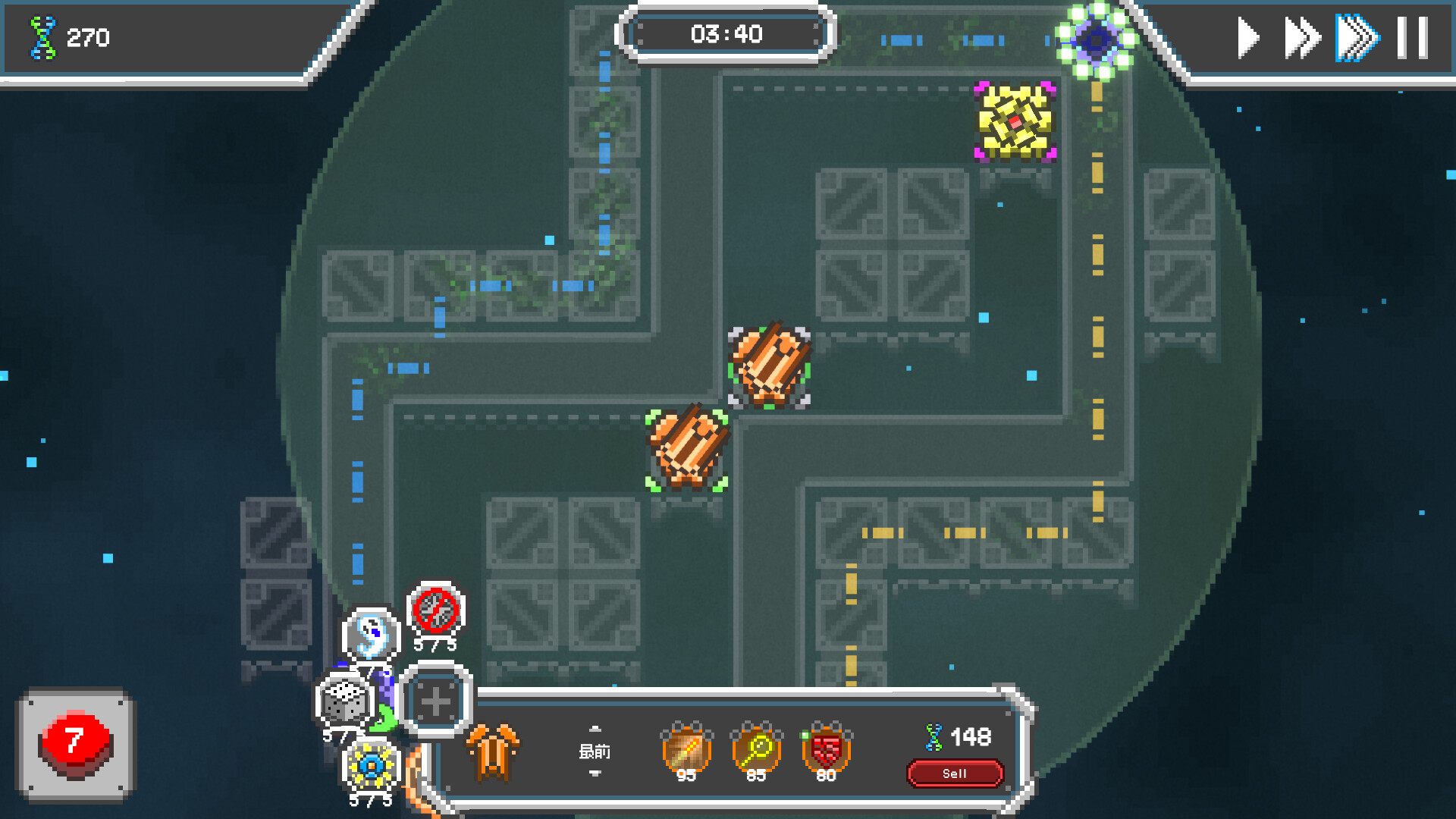
The Construction phase is where the game earns its "unparalleled" boast, or at least makes a credible attempt. You deploy modules to redirect enemies, which means you're not just placing towers along a fixed path; you're drawing the path.
The listing mentions six defense modules, each with three unique upgrade paths, but the crucial restriction is that a single tower can choose up to two paths, and only one of those can be fully upgraded. That's a real constraint. It means every tower is a compromise, and the crossfire zones you build are shaped by what you're willing to give up.
It's the kind of rule that makes a 135-node Research Tree feel less like a checklist and more like a series of small, permanent decisions.
The four modification systems are the other half of that puzzle. The store page describes them as "game-changing," which is marketing, but the actual options are specific: high-risk, high-reward tactical trade-offs; a bloodthirsty modification that grows stronger with each battle; sacrificing a single tower for global bonuses; or risking a shutdown for maximum damage output.
I haven't played enough to tell you which one is optimal, but I can tell you that the existence of a modification that asks you to kill one of your own towers for the good of the run is the sort of thing that makes a strategy game worth arguing about.
The combat phase is a deckbuilder with a countdown
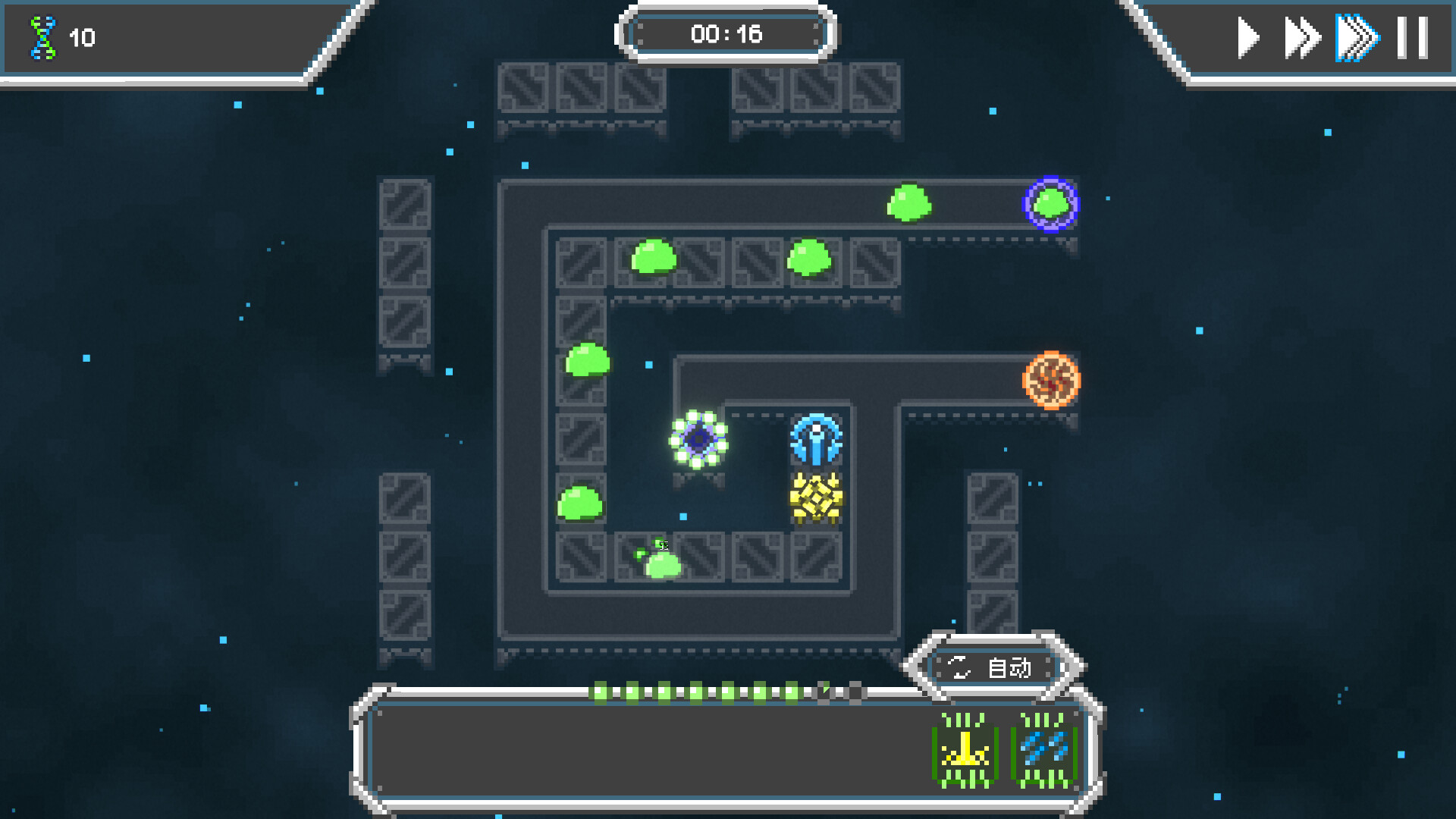
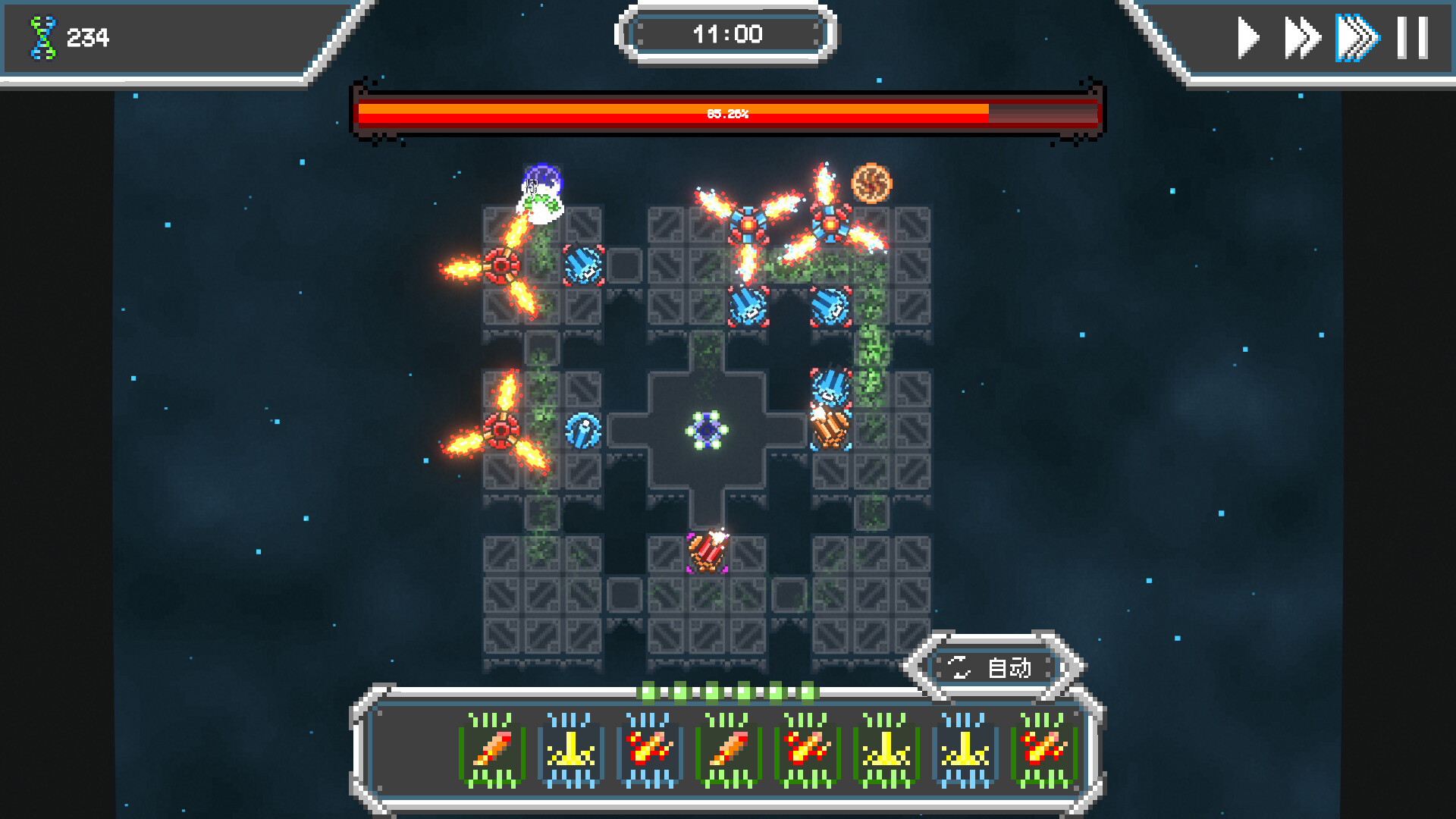
Combat is where Stellacore Defense gets weird in a good way. No new facilities can be built. The battlefield is controlled by the tactical chip system, and each defense tower has its own exclusive chip. A draw pile is generated based on the number of towers on the field, identical chips can be synthesized and upgraded to level 3, and every chip activation costs Stellacore energy.
That last part is the kicker: the maximum Stellacore energy decreases as energy blocks are stolen, and defeating energy-carrying enemies recovers it. So your resource pool is both your life total and your mana, and it shrinks unless you're actively killing the right enemies.
That's a tighter loop than most tower defense games manage. It reminds me of the tension in Slay the Spire, where every card play is a calculation about whether you can afford to wait one more turn. Here, the calculation is spatial as well as economic: you're spending energy to trigger chips that buff, debuff, or attack, and the chips you have are determined by the towers you built.
If you built a narrow maze with two fully upgraded towers, your deck is thin. If you spread out, your deck is fatter but your towers are weaker. The game is asking you to build your own deck during the Construction phase, then play it under pressure. That's a genuinely interesting inversion of the usual tower defense rhythm, and it's the reason I think this game is worth $5.94 even if you bounce off the story.
The numbers are small, and that's the point
Here's the honest part: Stellacore Defense is not a hit yet. It released on Oct 27, 2026, and as of this writing it has 1 current player on Steam. One. That's not a failure; it's a game that launched yesterday with no review quotes and no marketing push, and the only people playing it are the ones who found it by accident. The ratio of ambition to audience is lopsided.
But the content volume is real: 27 story levels, all compatible with both Story and Endless modes, 35 dimensional native creatures across 14 minions, 11 elites, and 10 bosses, and a 135-node Research Tree covering general upgrades, tower enhancements, modification unlocks, and defensive mechanisms. For $5.94, that's a lot of systems to poke at.
The honest reservation is that the game's depth might be theoretical until you've unlocked enough of the Research Tree to see the interesting combinations. The listing promises "no mindless grinding," but a 135-node tree implies some grind by definition. The difference is whether the nodes are choices or chores, and I can't tell you that from the store page alone.
What I can tell you is that the two-phase structure is the kind of idea that either sings or collapses under its own complexity, and the fact that the game exists at all at this price is worth a look.
Who should skip it
If you want a tower defense game where you can plop down a new turret mid-wave and watch it save the day, Stellacore Defense will frustrate you. The Combat phase is deliberately restrictive, and the chip system means you're often reacting with buffs and debuffs rather than raw firepower. If you bounced off Balatro because you wanted more direct control, this might feel similarly hands-off.
And if you need a game with a bustling community right now, one current player is a lonely number.
But if you're the kind of person who reads a store page and thinks, "I want to build a maze that forces enemies into a crossfire zone, then play a card game inside that maze," this is the most interesting $5.94 you'll spend this week. Slash Studio has made a tower defense game that trusts you to plan ahead and then punishes you for planning wrong. That's not unparalleled depth.
But it's a real idea, and at this price, it's worth finding out whether it holds.