Scam With Your Friends Preview: AI Callers Turn Co-op Improvisation Into the Main Mechanic
Scam With Your Friends is an upcoming co-op comedy game about operating a fictional scam call center, manipulating AI-controlled callers, hitting daily quotas, and surviving escalating office disasters. At 1:16 p.m. Malaysia time on October 4, it appeared eighth in the checked Steam Popular Upcoming list, the strongest storefront position among the three games in today's preview set.

Scam With Your Friends is an upcoming co-op comedy game about operating a fictional scam call center, manipulating AI-controlled callers, hitting daily quotas, and surviving escalating office disasters. At 1:16 p.m. Malaysia time on October 4, it appeared eighth in the checked Steam Popular Upcoming list, the strongest storefront position among the three games in today's preview set.
The premise is intentionally uncomfortable: players perform exaggerated criminal schemes inside a satirical simulation. This article describes the game, not real-world conduct, and does not provide instructions for fraud. It is a prelaunch market analysis based on official store materials, not a hands-on review.
Why It Is Visible Now
The public list places the game high among imminent releases, while the store gives only “October 2026” rather than a specific day. That combination creates attention and uncertainty. The rank is evidence of storefront visibility at the check time; it is not evidence of sales, wishlists, or a final release build.
The hook is also unusually streamable. Conversations can generate different responses, a team can improvise around missing information, and office chaos can interrupt the plan. If the AI-controlled callers are responsive and bounded enough to preserve the scenario, each run can create clips without relying entirely on scripted dialogue.
Genre, Platform, and Release Status
JakeHub and Metater are listed as developers, with Jatater Worldwide as publisher. The current Steam app data lists Windows, single-player, multiplayer, online co-op, adjustable difficulty, custom volume controls, stereo sound, and family sharing. The game is tagged as action, casual, indie, simulation, and early access.
No Steam demo appeared in the checked app-data response. Steam showed no released-product review summary, Metacritic result, or concurrent-player figure. The store description promises public lobbies as well as play with friends, but network quality and moderation were not independently tested.
The Core Loop
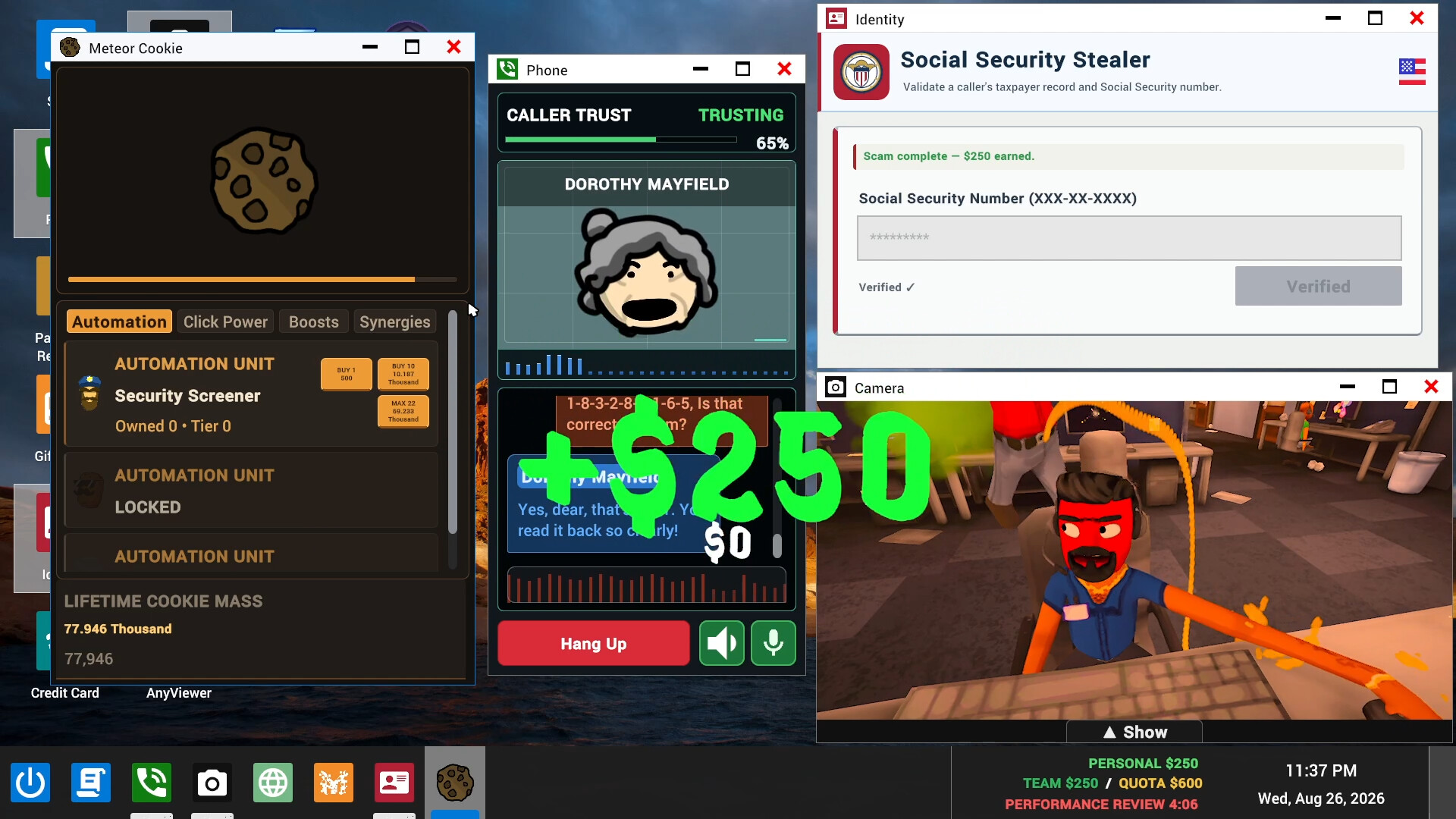
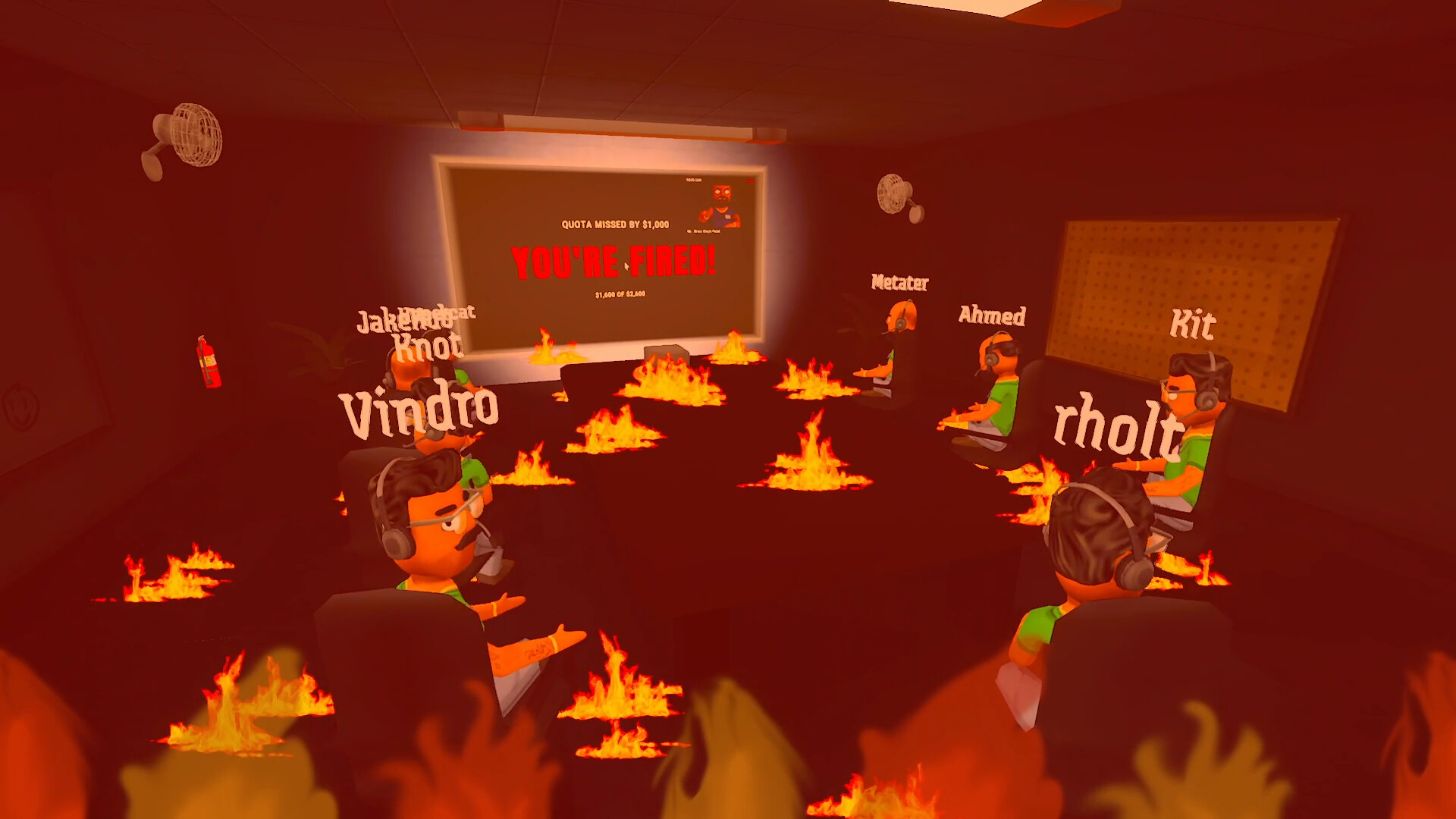
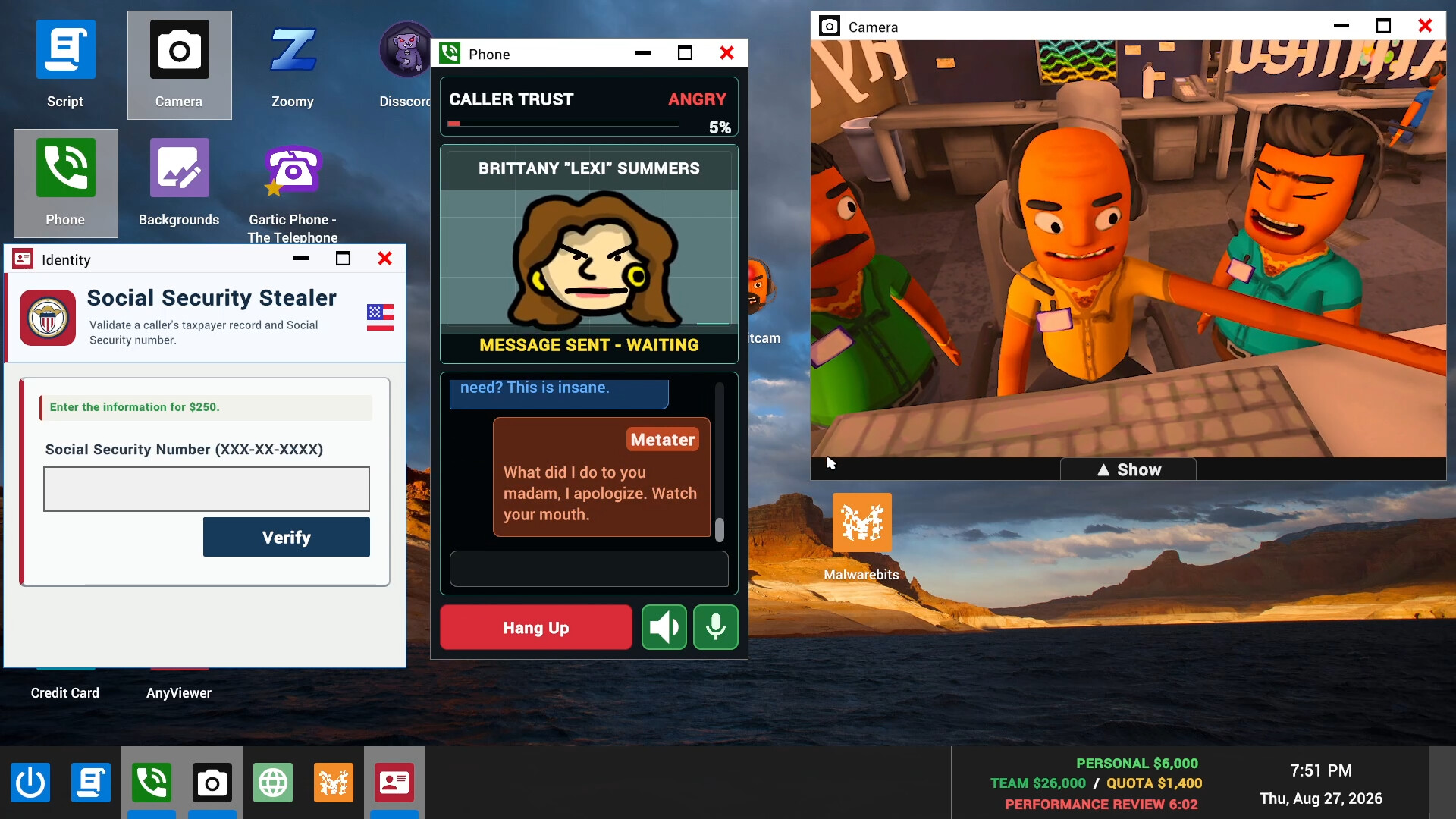
Players receive targets, converse with AI callers, access fictional information on in-game computers, assemble a scheme, and try to meet a quota before a hostile performance review. Progress expands the set of scenarios. Runs can also be disrupted by scambaiters, computer viruses, police raids, and deliberately absurd workplace events.
The design challenge is to make conversation part of a game rather than an open microphone attached to a chatbot. Clear goals, limited tools, caller personalities, time pressure, and consequences can turn language into decisions. Without those boundaries, dialogue risks becoming either repetitive or impossible to balance.
The store also advertises moddable content and JSON-defined personalities with voice-cloning WAV files. That could extend variety, but it creates a serious moderation and rights burden. Players should use only voices and material they have the right and consent to use. A game's mod support does not waive privacy, impersonation, copyright, or platform rules.
What Makes It Different
Many co-op workplace games create comedy from physical mistakes: objects collide, customers wait, and machinery breaks. Scam With Your Friends appears to put improvised speech at the center while retaining a visible production line of quotas, computers, and disruptions.
The real-time AI element could produce stronger variation than a fixed dialogue tree. It could also become the product's largest risk. Latency can damage comic timing. Safety filters may collide with an intentionally transgressive premise. Callers may repeat themselves, misunderstand accents, or respond unpredictably to harassment. Privacy expectations must be explicit if voice input is processed remotely.
The theme presents another risk. Satire needs enough distance and consequence that the game reads as a critique or farce rather than a celebration of victimization. The official presentation is exaggerated, but launch reviews will reveal whether writing and systems sustain that distinction.
Market Signal and Review Evidence
The current momentum signal is Steam Popular Upcoming rank 8 for the checked region and category. The release field says October 2026, and there was no public review or player sample. No private wishlist or sales figure is claimed.
Because there are no launch reviews, this article does not manufacture a praise-versus-complaint consensus. After release, the useful recurring patterns will include caller variety, speech recognition, AI response latency, co-op synchronization, moderation, progression repetition, and whether the joke remains enjoyable beyond a few sessions. Review analysis should state its sample and separate technical complaints from objections to the premise.
Competitors and Positioning
The co-op quota structure invites comparison with Lethal Company and R.E.P.O., while office-task chaos recalls games such as Content Warning or Job Simulator in tone rather than exact mechanics. The conversational premise is closer to AI-driven improvisational games, but the call-center setting gives the interaction a shared operational goal.
The strongest advantage is legibility: viewers immediately understand a quota, an angry boss, a computer, and a call going wrong. The disadvantage is dependence on a model service whose behavior and cost may change. A durable game needs fallback behavior, reproducible rules, and enough authored structure that it remains playable when the generative layer fails.
Audience Fit and Purchase Cautions
This is for adult groups comfortable with dark satire, improvised voice play, and an early-access product. Players sensitive to fraud themes, harassment, or workplace abuse should inspect unedited footage and content warnings. Anyone planning to use custom voices should avoid impersonating real people without explicit permission.
Cautious buyers should wait for a firm date, price, privacy explanation, service-availability details, and launch reviews. Verify language support, microphone requirements, moderation controls, and whether AI features require a persistent external connection.
Editorial Verdict
The game has a strong discovery signal and a mechanically relevant use of conversational AI rather than an AI label pasted onto a conventional loop. That is enough for a watchlist, not a purchase recommendation. The launch will be decided by latency, moderation, consent boundaries, repetition, and whether the satire can remain funny without making the fictional victim merely a resource meter.
Sources and Image Rights
- Official Steam store page: https://store.steampowered.com/app/4954910/
- Official Steam public app-data endpoint: https://store.steampowered.com/api/appdetails?appids=4954910
- Official developer/publisher page: https://jataterworldwide.com/scam-with-your-friends/
- Steam Popular Upcoming discovery page: https://store.steampowered.com/search/?filter=popularcomingsoon&category1=998
- Checked October 4, 2026 at 1:16 p.m. MYT. Market signal: rank 8 in the checked Popular Upcoming result; no sales, wishlist, review, or player estimate.
- Image rights: header and three screenshots are official Steam store assets supplied by JakeHub, Metater, and Jatater Worldwide, downloaded locally for identification, reporting, and criticism; no compositing or semantic alteration.