Paver: Tidy Up Together Turns 4,064 Tiles Into a Co-op Progress Bar
Paver: Tidy Up Together reduces an entire game pitch to one visible job: place 4,064 scattered paving stones back into a palace plaza. That number is not decorative store copy. It is the progress structure, the division of labor, and the before-and-after spectacle.
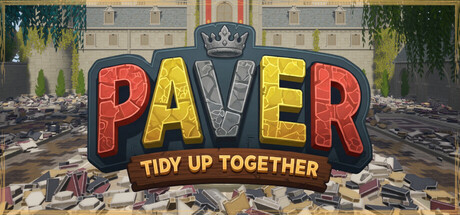
Paver: Tidy Up Together reduces an entire game pitch to one visible job: place 4,064 scattered paving stones back into a palace plaza. That number is not decorative store copy. It is the progress structure, the division of labor, and the before-and-after spectacle.
At 13:17 MYT on September 19, Steam's public endpoints showed 670 players currently in game and 78 public reviews, including 70 positive and 8 negative—89.7% positive. The game launched on September 18. Those figures describe a promising first day for a small, focused simulation; they do not disclose sales, refunds, or long-term retention.
This is a launch and market analysis based on official materials and public review signals, not a hands-on review.
Why the game is visible now
Paver arrived when “tidy up” games already had a recognizable audience, but its chosen mess is unusually legible. A pile of mixed tiles surrounds an incomplete geometric floor. Every correct placement restores a piece of an obvious larger pattern. A viewer can understand the labor and reward before learning a control.
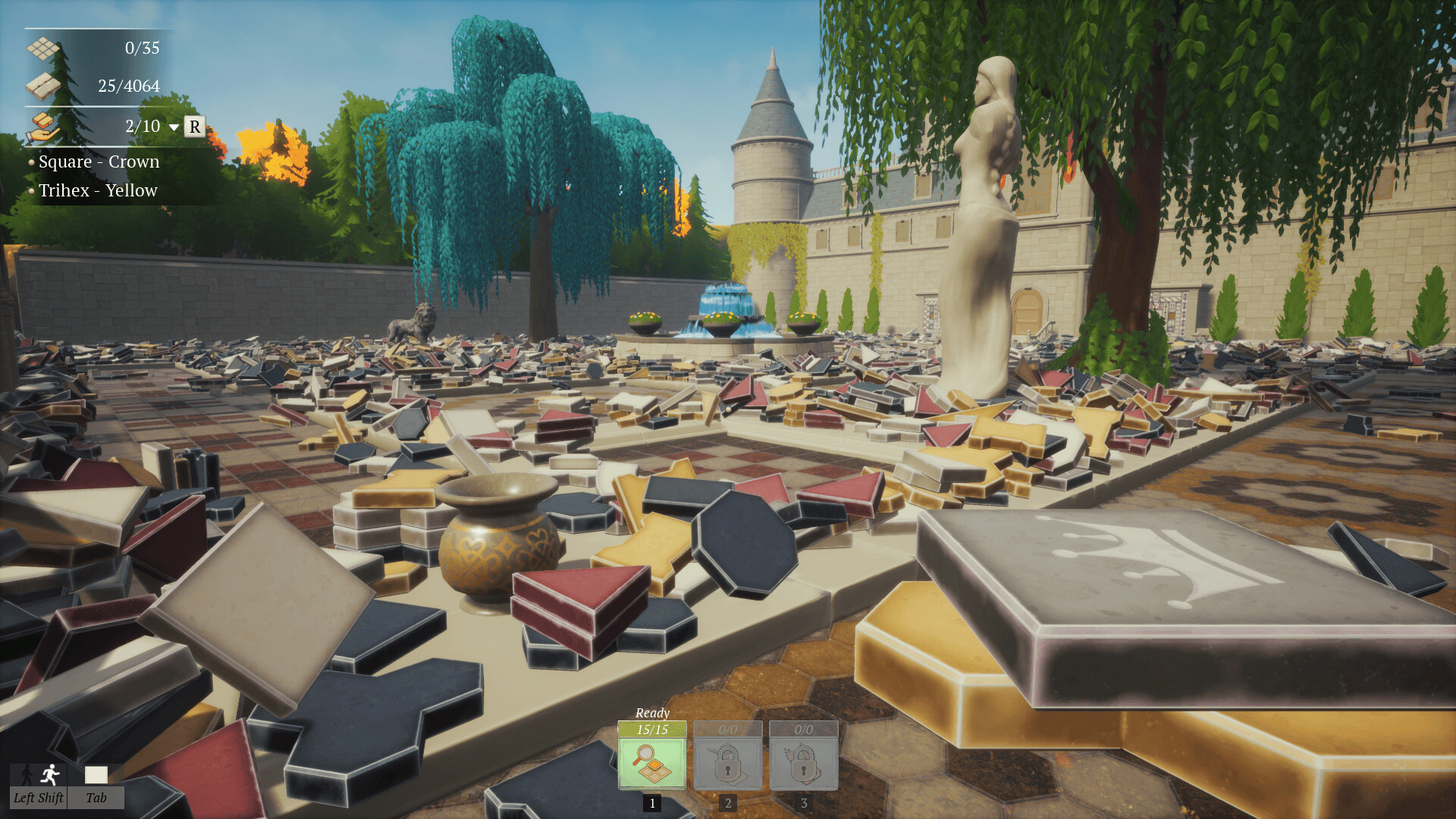
The first-day count is not a breakout on the scale of a major simulator franchise. It is meaningful because the design is narrow: one setting, one dominant action, and one communal completion goal. A current audience in the hundreds and dozens of reviews suggests that the pitch converted beyond a tiny circle of wishlisters.
The market report selected Paver as its strongest signal because the game makes low-complexity labor visually cumulative. That principle travels well in clips and co-op streams: a chaotic square becomes an ordered mosaic in measurable increments.
Genre, platform, and release status
Steam lists Paver as a released Windows title in the casual, indie, and simulation categories. It supports single-player and online co-op, full controller input, achievements, cloud saves, and family sharing. The official page also highlights accessibility-oriented options such as custom volume controls, save-anytime support, and play without timed input.
The game is not a city builder or an architecture simulator. Players are not designing a plaza from scratch or managing contractors. They are solving a huge spatial sorting task inside an authored environment.
That distinction matters for buyers. The pleasure comes from execution, recognition, and completion—not strategic freedom. The scope is a strength if the tactile loop feels good and a weakness if a buyer expects many sites or systemic construction.
The core play loop
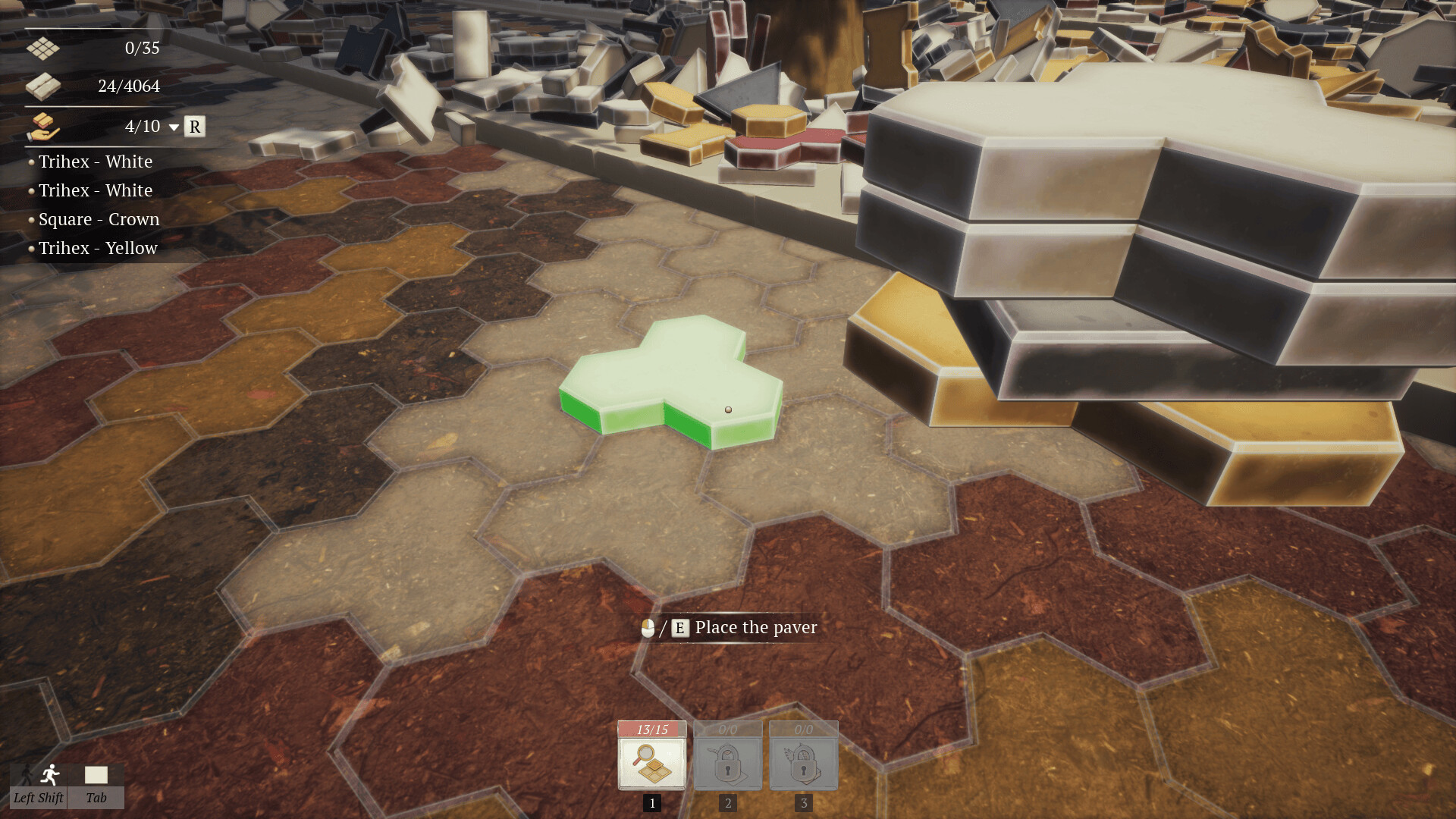
The loop is gather, identify, carry, place, and reveal. Tiles differ by shape and color. The floor itself communicates valid positions, reducing the memory burden common in inventory-sorting games. Skills increase efficiency, while sandbox access allows a less constrained version of the task.
The design uses physical piles as both problem and interface. Instead of selecting pieces from a menu, players move through the environment, inspect the tiles they hold, and find the corresponding gap. The correct pattern gradually emerges underfoot.
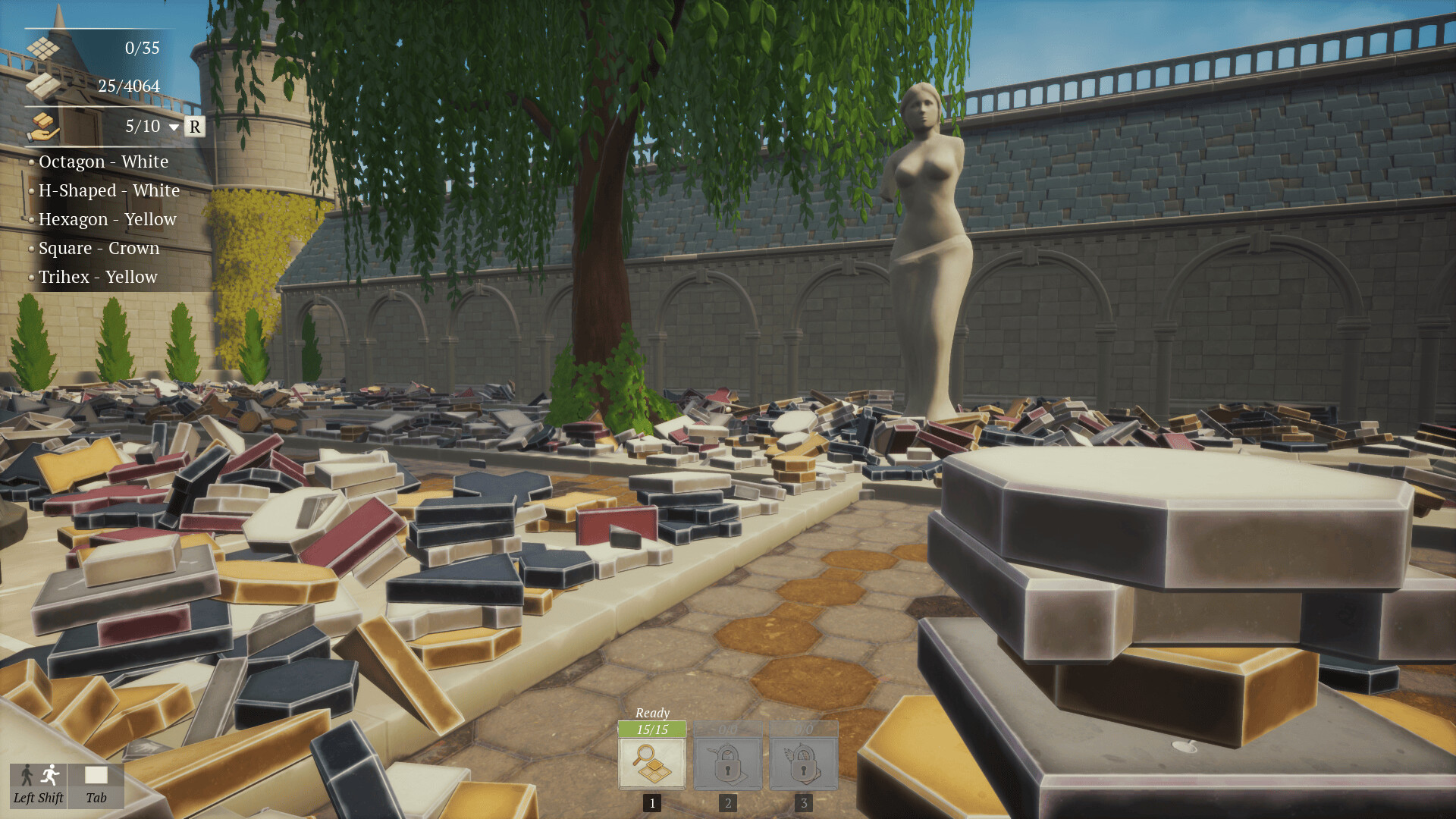
Co-op changes the psychology more than the verbs. A group can split the plaza by region, specialize by color or shape, or simply clean in parallel. Every placement contributes to the same visible object. There is little ambiguity about whether another player helped.
That is a useful co-op lesson. Many games add multiplayer by duplicating independent tasks. Paver makes the shared artifact itself the social feedback. Players can look across the plaza and see collective progress without opening a scoreboard.
Verified market snapshot
The launch evidence checked on September 19 supports a limited but concrete summary:
- release date: September 18, 2026;
- platform: Windows through Steam;
- modes: solo and online co-op;
- current players at 13:17 MYT: 670;
- public reviews: 78 total, 70 positive and 8 negative;
- calculated positive share: 89.7%;
- official promise: restore a plaza by placing 4,064 pavers;
- official sales, revenue, refund, and completion figures: not published.
Current players are a live snapshot, not daily active users. Reviews are self-selected and still a small launch sample. The correct interpretation is “clear early interest with a strong positive skew,” not “proven long-term hit.”
What public reviews repeatedly praise
The public review sample repeatedly describes the game as relaxing, intuitive, and satisfying. Players value the combination of low cognitive load and visible pattern completion. Several compare it favorably with tidy-up games that require memorizing brands, categories, or shelf locations.
The strongest praise is about accumulation. A single placed tile is trivial, but a restored mosaic creates a powerful before-and-after result. Co-op comments emphasize that connected patterns make shared work more tangible: the group is not merely increasing a number; it is finishing one object.
The pleasant music and environment also appear repeatedly. That matters because a game built around thousands of similar interactions needs audio and scenery that can remain present without becoming exhausting.
Where the complaints concentrate
Negative and mixed comments cluster around technical friction and limited scope. Players report occasional tiles that appear impossible to place, input awkwardness, save concerns, or a final piece blocked by an invisible obstacle. In a 4,064-step task, a single placement bug near completion is disproportionately damaging.
Other reviewers want more worlds or levels after finishing the plaza. That is the product's central tension. The handcrafted pattern gives the game identity, but new content may require another large environment and thousands of authored placements.
Solo repetition is another risk. Co-op conversation and division of labor can mask monotony; alone, the same loop may feel meditative to one player and thin to another. The store page should be read literally.
What it means beside competing tidy-up games
Paver belongs near games built around cleaning, unpacking, renovation, and object organization. Its differentiator is not narrative discovery or a catalog of chores. It is one enormous tessellated puzzle performed physically in first person.
Compared with room-by-room organization, the plaza offers a more public sense of scale. Compared with construction simulators, it avoids complex machinery and economics. Compared with a conventional jigsaw puzzle, it makes travel, carrying capacity, and cooperation part of the solution.
That compression lowers the tutorial burden and makes the game streamable. It also leaves fewer alternative systems if the core feel does not land.
Who should play—and who should wait
Paver is best suited to players who enjoy PowerWash Simulator-style progress, methodical sorting, calm co-op, and long tasks that produce a dramatic final image. It may work especially well for a regular pair or small group that wants conversation-friendly play without combat pressure.
Wait if you require a campaign of many locations, procedural variety, deep building design, or a completely proven save and placement system. Players bothered by repetitive manual work should not assume that unlockable skills transform the genre.
IndieGame.party verdict
Paver: Tidy Up Together is a smartly scoped launch with a marketable one-sentence loop and a credible early audience. Its best idea is turning cooperative labor into one persistent visual artifact. Its biggest risk is that the 4,064-tile promise magnifies every placement and save defect.
Our verdict is recommended for tidy-up fans and relaxed co-op groups; cautious for solo players who need systemic variety.
Data and image sources
- Official Steam listing and developer materials: https://store.steampowered.com/app/5120650/
- Steam public review endpoint: https://store.steampowered.com/appreviews/5120650?json=1&language=all&purchase_type=all
- Steam public current-player endpoint: https://api.steampowered.com/ISteamUserStats/GetNumberOfCurrentPlayers/v1/?appid=5120650
- Market snapshot checked September 19, 2026 at 13:17 MYT.
- The hero and three in-article images are official Steam store assets, © Games Together and Gamersky Games, downloaded from the official listing on September 19, 2026, stored locally without compositing, and used in the minimum scope needed to identify and analyze the game.