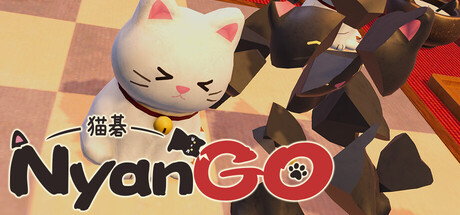
NyanGo Shrinks Go to a 4×4 Cat Fight Where Three Stuns Shatters a Piece
NyanGo is push-style Go on a 4×4 board with cat pieces that crack and shatter after three stuns. It costs $0.99, and the design is meaner than the art suggests.
<figcaption>Official trailer — NyanGo</figcaption>
</figure>
The pitch is the punchline
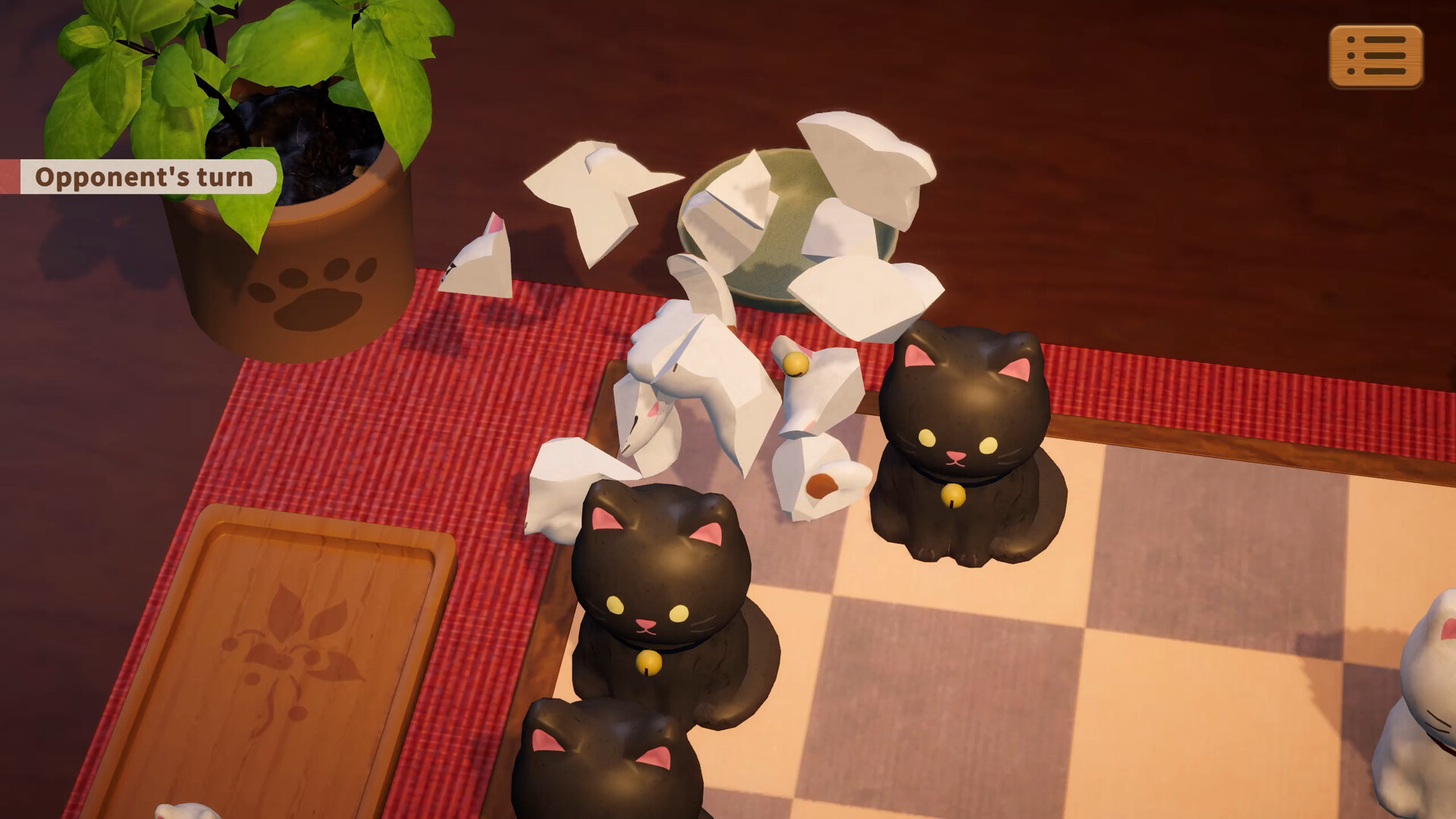
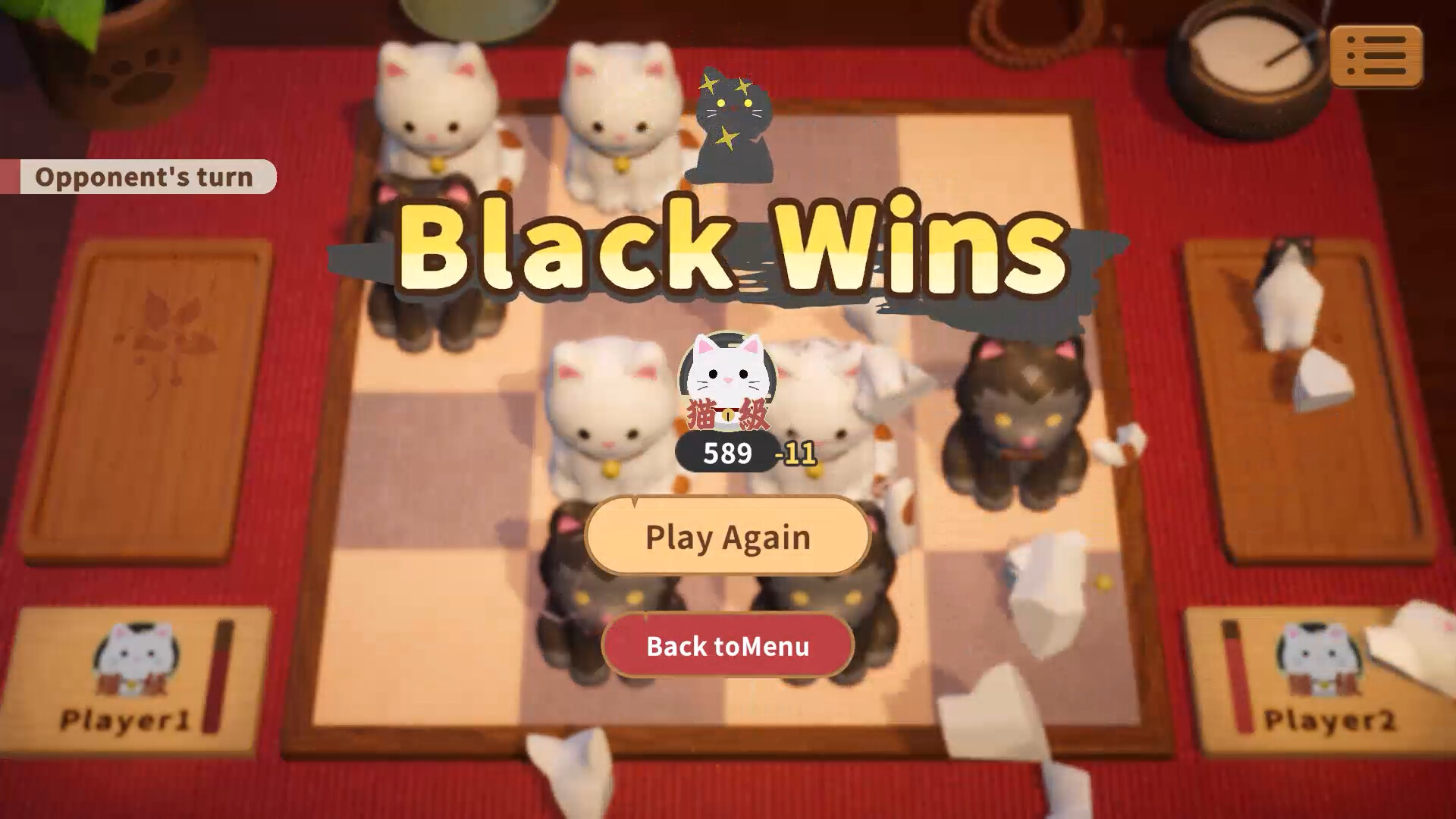
A cat that has been shoved three times shatters. Not faints, not retreats — shatters. That single rule is the whole personality of NyanGo, a $0.99 board game from NIUWORKS that takes the surround-and-capture logic of Go and compresses it onto a 4×4 grid where every piece can be pushed one square in any orthogonal direction.
I keep thinking about how much violence that implies for a game whose store page is decorated with adorable cat pieces. The cute is the bait. The board is the trap.
The game released on Oct 28, 2026, for Windows, and it is published by NIUWORKS themselves. It is tagged Casual and Indie, which feels like a misdirection once you read the rules: surround a cat or a connected group with your pieces or the board edge, or stun an opponent's cat three times until it cracks apart and its owner instantly loses. That is not a casual premise. That is a knife fight in a shoebox.
What strikes me most is how completely the store page leans into the deception. The screenshots are all soft edges and round faces; the genre tags promise something you can play with a podcast on. Then you read the two win conditions and realize the game has more in common with a sumo bout than a picnic.
The shatter rule is not a garnish on top of a Go-like — it is a second, faster clock running underneath the first, and it changes what every single move is for. A game that only asked you to surround would be a puzzle.
A game that also asks you to keep your cats from cracking is a threat-management exercise, and the difference between those two things is the difference between a coffee-table distraction and something you argue about afterward.
What you actually do on a 4×4 board
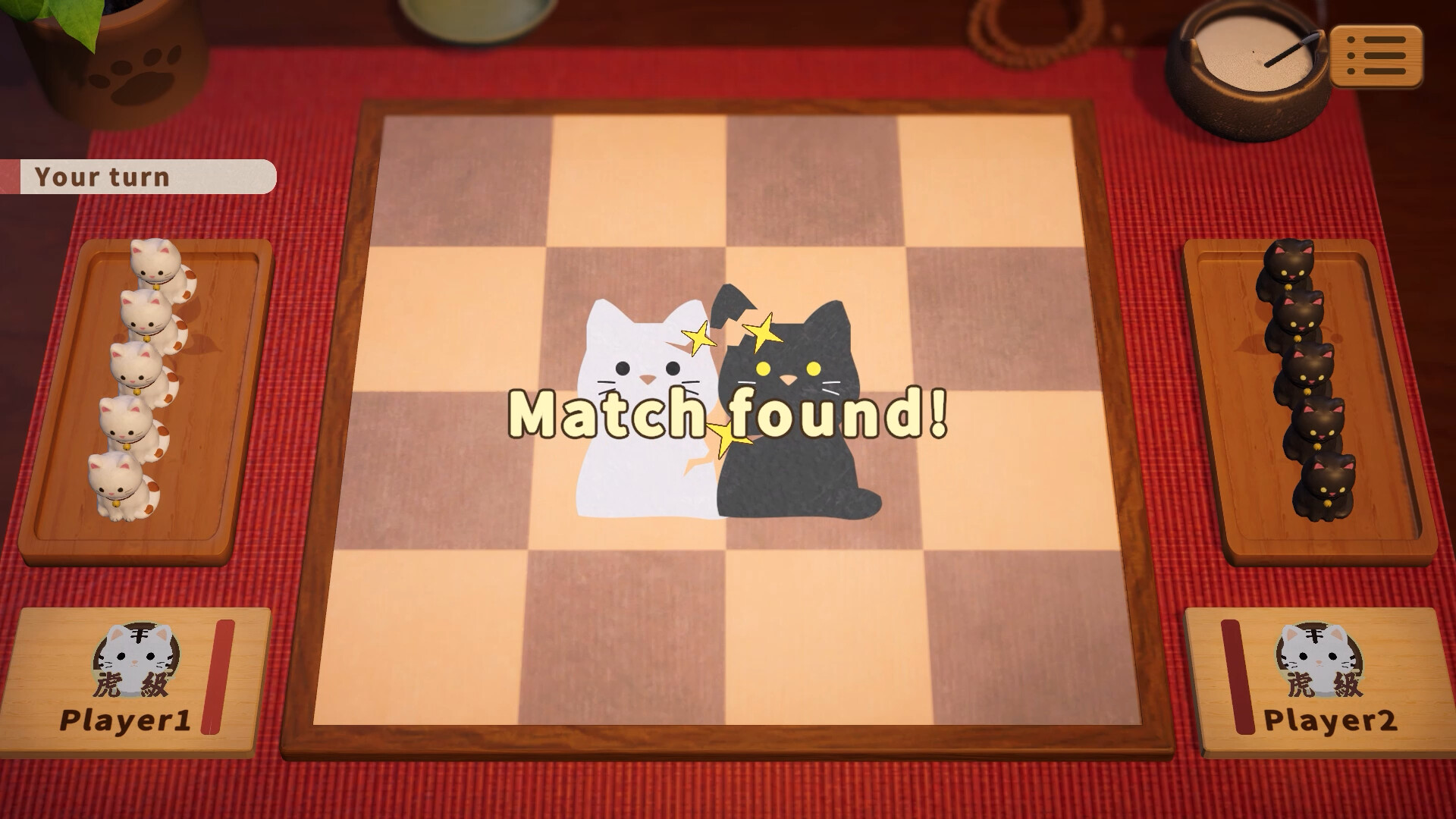
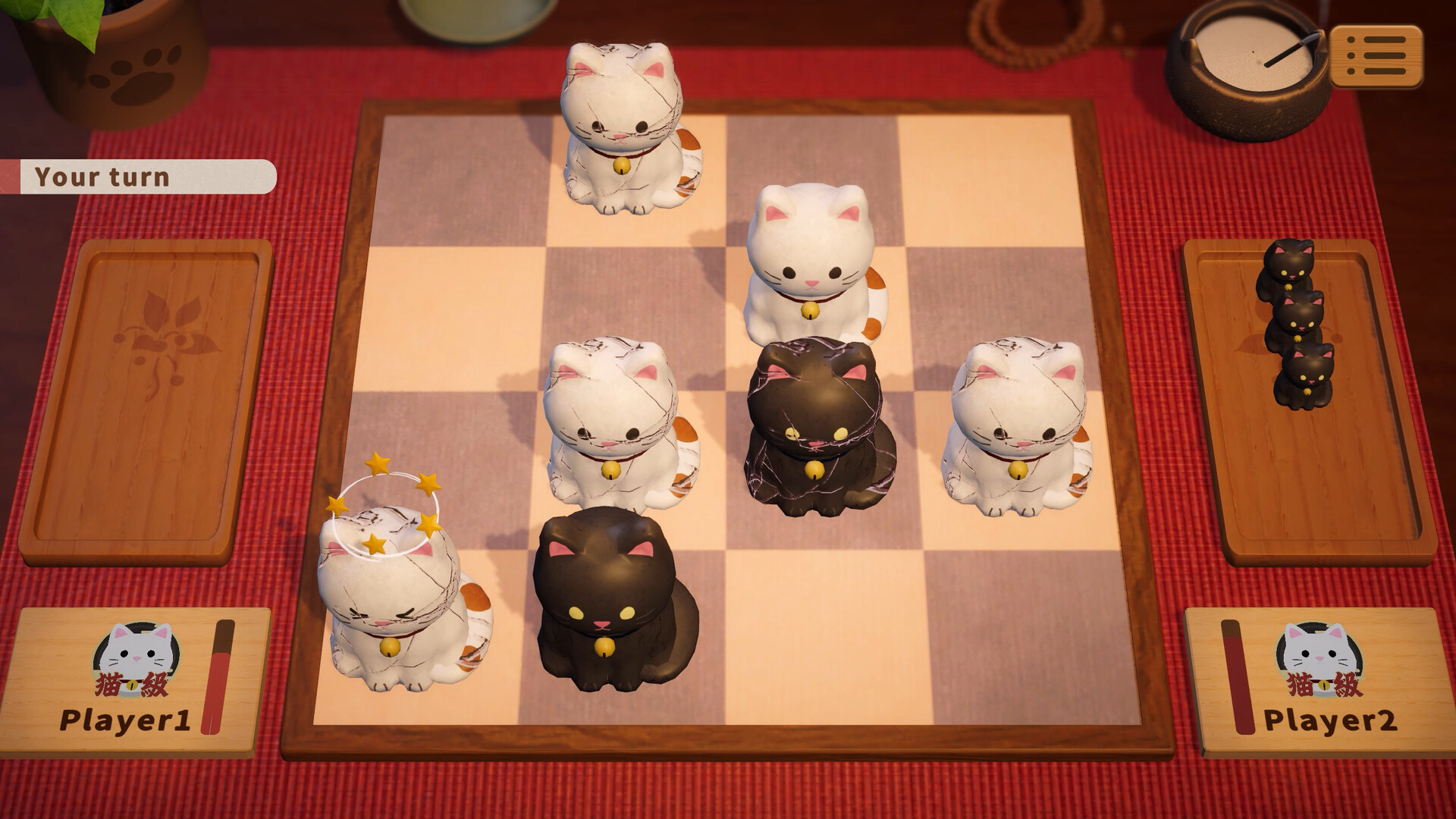
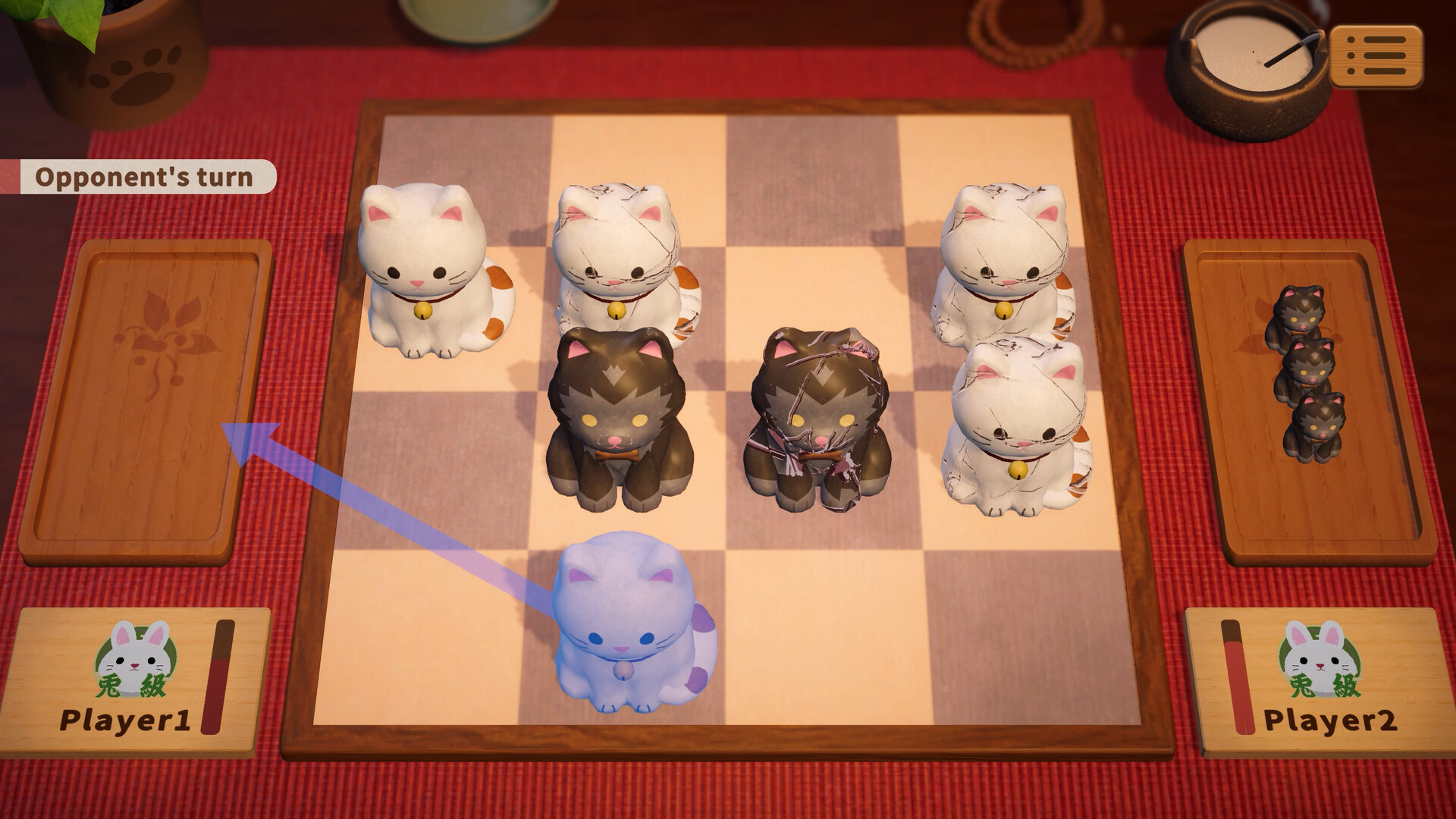
Each player has five cat pieces. On your turn you choose one of three actions: place a cat from your hand on an empty square, move a cat one square up, down, left, or right — pushing any cat in the way — or take back a cat once all five are on the board. That is it. Three verbs, sixteen squares, five pieces each.
The tension comes from the fact that pushing is both attack and defense: you shove a cat to break a surround, but that same shove leaves a crack, and three cracks ends the game.
The comparison that keeps surfacing in my head is Go, obviously, but also Hive and the tightest parts of Onitama — games where the board is small enough that every move is legible and the real game is the threat assessment in your opponent's head. NyanGo borrows Go's surround-to-capture win condition and then adds a second, faster clock: the stun counter.
That second clock is what makes it feel less like a abstract strategy classic and more like a fighting game with a chip-damage mechanic. You can lose by being surrounded, or you can lose because someone kept poking you.
Walk through a turn and the geometry gets uncomfortable fast. Sixteen squares, ten pieces total at full deployment, means the board is more than half full before anyone has done anything clever. Every placement narrows the empty space; every push rearranges the walls.
The take-back action matters more than it looks on paper, because pulling a cat off the board is the only way to un-crowd a corner you have already committed to — and it costs you a tempo you may not have. The three verbs are not three flavors of the same move. Placing builds the cage, moving springs the trap or escapes it, and taking back admits you built the cage in the wrong place.
Knowing which of the three you actually need, on a board where your opponent can see everything you can see, is the entire game.
The loop is the ladder, and the ladder is the problem
NyanGo has four modes: Random Match (ranked online), Passcode Match (play a friend with a shared code), Level Challenge (CPU opponents of increasing strength, playable offline), and Local 2-Player hot seat with Remote Play Together support. The ranked ladder runs Rabbit → Cat → Tiger → Wolf → Ox Class, and clearing the Level Challenge or reaching new ranks unlocks Rabbit, Tiger, Wolf, and Ox pieces.
So the progression is cosmetic in the sense that the pieces are still cats, but the ladder gives you a reason to keep playing past the first hour.
The mode list is worth reading as a design statement. Passcode Match means the game expects you to have a specific person to play against, not a lobby of strangers. Level Challenge being playable offline means the CPU ladder is the on-ramp, and it is the only part of the game that works without anyone else showing up.
Remote Play Together support on the local mode is the quiet, practical touch — it turns a hot-seat game into a screen-share game for two people who are not in the same room, which for a $0.99 title is a meaningful amount of reach for very little infrastructure.
Here is my honest reservation: a 4×4 board with five pieces each is not a lot of board. The design is elegant, but elegance can curdle into solvability. I have not played enough to know whether the stun mechanic creates enough branching to keep ranked play interesting after the novelty wears off, but the risk is real. Games like this live or die on whether the opening move set is deep enough to support a ladder.
NyanGo's answer is the push-and-stun layer, which adds a second win condition and a reason to move pieces rather than just place them. Whether that is enough to sustain an Ox Class meta is the open question.
What the numbers say on day two
The game launched on Oct 28, 2026, and as of this writing Steam shows zero current players. That is not a death sentence — it is a snapshot taken at the wrong moment for a $0.99 game with no marketing budget — but it does mean the ranked ladder is going to be lonely for a while. There are no player quotes on the store page yet, which is also unsurprising for a game that has been out for roughly a day.
What I can judge is the design on the evidence: three actions, two win conditions, one shatter rule, and a price low enough that the risk of trying it is almost nil.
The $0.99 price is the real story here. NyanGo is not asking you to commit a weekend. It is asking for a dollar and twenty minutes to learn the rules. That is the same bet Balatro made with its first hour — a simple hook that reveals a mean little engine underneath — except NyanGo is doing it with a board game rather than a deckbuilder. If you have ever wanted a Go-like you could teach someone in a pub, this is that game.
A zero-player count on day two also tells you something about how this game is meant to be found. It is not going to be discovered through a bustling matchmaking queue; it is going to be discovered by one person buying it, learning the shatter rule, and then dragging a friend into a Passcode Match.
The four modes are arranged for exactly that path: the CPU ladder teaches you, the passcode mode gives you someone to beat, and the local mode gives you a couch. The ranked ladder is the aspirational ceiling, not the front door.
What the community is saying
The store page's player quotes are worth reading closely, because they describe two different games. One player writes: "Simple rules but deep strategy. The push mechanic adds a layer of mind games I didn't expect from a cat game." That is the design thesis stated back to me by someone who has actually moved the pieces — the push is not a gimmick, it is the mind game.
Another writes: "Lost my first three matches to the shatter rule before I realized I was the one cracking my own cats." That is the other half of the story: the second clock does not just threaten you, it punishes the way you naturally play. A new player's instinct is to shove aggressively, and shoving aggressively is how cats break.
A third quote lands on the price: "For a dollar it's an easy recommendation, especially if you have someone to play with locally." Notice the qualifier. Even the positive quotes point at the same constraint I keep circling — this is a game that wants a second person, and the dollar is what makes asking that second person low-stakes. Nobody in the quotes is claiming the ranked ladder is thriving.
They are claiming the game is worth a dollar and a friend, which is a smaller and more honest claim.
What NyanGo does that its comparisons do not
Go does not have a shatter rule. Hive does not have a board edge that counts as a wall. Onitama does not let you push your opponent's pieces. The comparisons are useful for locating NyanGo in the strategy aisle, but each one breaks down at the exact point where NyanGo gets interesting. In Go, a surrounded group is dead and that is the end of the conversation; here, a surrounded cat can be shoved free, at the cost of a crack.
The board edge is not just a boundary — it is a participant, because it can complete a surround without you spending a piece. And the stun counter means that even a cat that escapes every surround is still accumulating damage, so defense is never fully safe.
That combination is the specific thing I have not seen before. A Go-like where the capture condition can be dodged but the dodging itself is a resource. A game where the board edge is an ally you did not have to place. A game where the fastest way to lose is to play too aggressively with pieces you cannot afford to lose.
None of the games NyanGo gets compared to do all three at once, and the fact that it does them on sixteen squares is the reason the design is worth writing about rather than just worth a dollar.
Who should skip it
If you need a game with a campaign, a story, or a reason to keep playing after you have seen every piece, NyanGo will feel thin. The unlockable pieces are Rabbit, Tiger, Wolf, and Ox — different cats, same rules. The Level Challenge is a CPU ladder, not a narrative. And if you are the kind of player who bounces off abstract strategy because the board does not tell you a story, the 4×4 grid will not convert you.
But if you have a friend, a second controller, and a dollar, NyanGo is the kind of small, sharp design that deserves a look. The shatter rule is the detail that makes it worth writing about: three stuns and a cat breaks, and that is a mechanic I have not seen in a Go-like before. It is not a game-changer. It is a $0.99 experiment with a mean streak, and that is exactly the kind of thing this magazine exists to point at.
The verdict, such as it is
I cannot tell you NyanGo is a hit. Zero current players is not a hit. But I can tell you the design has a real idea in it: a Go-like where pushing is a resource, where every shove leaves a crack, and where the board is small enough that you can see the whole thing at once. That is a specific, legible hook, and it costs less than a coffee.
If you have been looking for a two-player game you can learn in five minutes and argue about for an hour, NyanGo is on Steam right now for $0.99. The cats are adorable. The shattering is not.