BOMBANANA!: A Three-Player Asymmetric Co-op Bet on Communication
This is a store-data check on BOMBANANA!, not a hands-on review — everything below is drawn from the official Steam listing as verified today.
This is a store-data check on BOMBANANA!, not a hands-on review — everything below is drawn from the official Steam listing as verified today.
The pitch
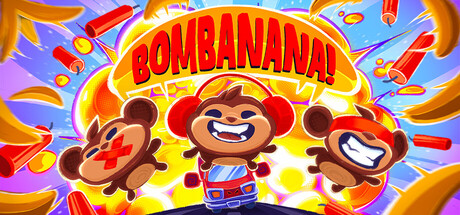
BOMBANANA! is a casual indie co-op game from developer Lefto Studio, published by TARK, listed for release on September 2, 2026 on Windows and Mac at $7.99. The store page describes a three-player bomb-disposal game built around deliberately broken communication: one player is a blind monkey who can touch but not see the bomb, one is a mute monkey who alone can read the disposal manual, and one is a deaf monkey who can see the bomb and the other players' gestures but hears nothing.
The framing is explicit about what the game is selling. The listing calls it "chaotic, explosively funny," warns players to "expect peak amounts of misunderstanding, unjust accusations, and desperate body language," and even stages a small genre argument with itself: "Some might call this game 'friendslop'. We disagree. If anything, it's a new genre: anti-friendslop, or perhaps an argument simulator." That is a marketing position, not a measured claim, but it tells you precisely which audience the store page is courting.
The feature list is unusually specific for a page at this stage: exactly three players ("No more, no less"), three modes (a 30-level campaign, procedural endless waves, and a custom mode with adjustable bomb difficulty, timer, module types, environmental hazards, and mistake allowance), an emote wheel supporting pointing, waving, gesturing and "flailing wildly," plus slapping, voice chat, puzzle modules, and environmental hazards such as power outages, obstructions and loud interruptions. New environments beyond the "trusty minivan" are teased, including a plane, though the listing does not enumerate the full set.
What the loop actually asks of players
Strip away the monkey costume and the design is a known cooperative pattern: asymmetric information, where each participant holds a fragment and the puzzle is solved by transferring that fragment to the others under time pressure. The listing is candid that it imposes no solution method — "wave, shout, throw bananas… Working out how you communicate is your job." That is the core promise, and it is also the core design risk, because the game's difficulty is partly outsourced to the players' ability to invent a shared language.
The three roles are meaningfully distinct on paper. The blind player is the only one with tactile access to the bomb; the mute player is the only one who can read the manual; the deaf player is the only one who can see the bomb and the others' body language. No single player can solve anything alone, and no two players share a complete channel. Voice chat is listed, with the wry note that "some of you can talk, some of you can't. You'll figure it out" — a hint that the mute role's constraint is enforced by the game rather than by social convention, though the listing does not spell out the exact mechanism.
The mode structure suggests the developers expect the campaign to function as a tutorial-to-mastery ramp (30 handcrafted levels with "increasing difficulty") and the endless and custom modes to carry the long tail. The custom mode's adjustable parameters — timer, module types, hazards, allowed mistakes — read as an acknowledgment that a communication game's difficulty curve is volatile across groups, and that players will want to tune it themselves.
What the listing does not tell us: matchmaking or lobby structure, whether the game supports anything other than exactly three players (it says no more, no less, so presumably not), session length, whether progression or unlocks exist beyond the campaign levels, or how procedural generation affects module fairness. None of these are stated, so treat them as open questions.
Where the risk sits
The first and largest risk is the player-count constraint. A game that requires exactly three people is asking for a specific social configuration — not a solo experience, not a duo, not a large party. That narrows the addressable audience considerably compared with one-to-four-player co-op, and it means the game's value proposition depends entirely on players having two available friends at the same time. The listing's own framing ("Will your friendship survive the ultimate test?") leans into this, but the constraint is structural, not cosmetic.
The second risk is communication friction. Asymmetric-information games live or die on whether the intended confusion is funny or merely frustrating, and the store page cannot demonstrate that. The design leans hard on emergent player behavior — emote wheels, gestures, improvised signals — which means the quality of any given session depends on the group. The listing's warning that "just because you keep talking, that doesn't mean nobody explodes" is honest about this, but it also concedes that failure is a feature.
The third risk is discoverability and price positioning. At $7.99 the game is priced in the impulse-buy band, which is sensible for a three-player curiosity, but the listing gives no indication of content volume beyond "30 handcrafted levels" — no stated playtime, no roadmap, no demo mentioned. Whether 30 levels plus procedural and custom modes constitutes enough value at that price is a judgment players will have to make without a stated hour count.
Fourth, the release date of September 2, 2026 places the game well ahead of any current visibility; the page is live and detailed, but there is no review data, no player-count data, and no hands-on evidence in the listing itself. All claims about tone and fun are the developer's.
Who this is for
This is for groups of exactly three who already enjoy communication-constrained co-op — the kind of players who find the fun in the breakdown rather than the solution. The asymmetric roles and the emote-driven signalling suggest it will appeal to players who like improvisation and are tolerant of failure states; the listing's "argument simulator" self-description is a fair signal that the intended emotional register is loud, messy and social rather than tense and precise.
It is less obviously for solo players, duos, or large friend groups, and less obviously for players who want a deterministic, mastery-oriented puzzle game where the challenge is the bomb rather than the conversation. The custom mode's tunable parameters may soften that, but the three-player requirement does not move.
What to watch next
- Whether a demo or playtest appears before September 2026. The listing makes strong claims about tone; a demo is the cheapest way to verify whether the confusion lands as comedy or frustration.
- Stated content depth. Watch for any clarification of campaign playtime, number of puzzle modules, or post-launch plans. The current page gives level counts but no hour estimates.
- Lobby and matchmaking details. With an exact three-player requirement, how players find each other — friend invites only, or public lobbies — will materially affect who can actually play.
- Localization and voice-chat handling. The game's core mechanic is communication; the listing is English-only in this data, and how voice chat interacts with the mute role is worth confirming before launch.
Verdict
BOMBANANA! is a tightly scoped, clearly pitched co-op game with a real design idea at its center: three players, three broken channels, one bomb. The store page is unusually forthcoming about mechanics and unusually honest about the fact that the fun is emergent and group-dependent. At $7.99 the price is low enough to make the exact-three-player requirement a smaller ask, but the absence of any hands-on evidence, playtime figures, or matchmaking detail means the listing currently sells a premise rather than a proven experience. It is worth tracking, and worth testing before buying — the pitch is coherent, but the execution is unverified.