Alchemy Factory 1.0 Gives Automation a Shopfront and a Reason to Matter
Alchemy Factory reached version 1.0 on September 7 with a practical answer to an automation-game problem: where do all the optimized products go? Here, conveyors and processing machines feed an alchemist's shop, so throughput becomes customer orders, reputation, research, and expansion rather than an abstract items-per-minute score.
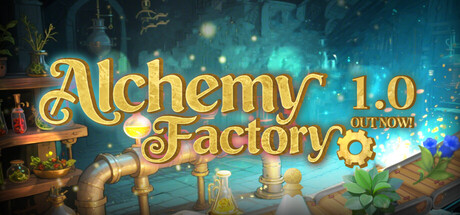
Alchemy Factory reached version 1.0 on September 7 with a practical answer to an automation-game problem: where do all the optimized products go? Here, conveyors and processing machines feed an alchemist's shop, so throughput becomes customer orders, reputation, research, and expansion rather than an abstract items-per-minute score.
On September 13, Steam's public review endpoint returned 2,682 reviews: 2,377 positive and 305 negative, or 88.6% positive. The morning market report recorded 3,347 current players, a 5,081 24-hour peak, and a 6,924 all-time peak. This is a market analysis and review-signal summary, not a hands-on review.
Why it is visible now
The 1.0 launch redesigned or expanded visible systems including carriage logistics, reputation, and store operation. That created a reason for early-access owners to return while giving new buyers a more complete proposition.

The current player count is not an all-time record, but it represents a substantial active audience for a week-old full release. More importantly, the review sample is already large enough to identify a generally positive consensus without pretending complaints are rare.
The public price snapshot for Malaysia showed RM36.00 during a 20% promotion, down from RM45.00. Regional prices and discounts change; the amount should be treated as a dated local observation.
Genre, platform, and status
Steam lists Alchemy Factory for Windows as a released single-player and cooperative simulation/strategy game. It supports online and LAN co-op, achievements, Workshop content, cloud saves, and family sharing.
The Workshop is strategically important. Blueprints and player-created solutions can function as tutorials, inspiration, and extended content. They reduce the gap between a novice staring at an empty floor and an expert who already understands ratios.
The game competes with Satisfactory, Factorio, Shapez, and shop-management simulations, but its fantasy materials and customer-facing output create a distinct tone. The relevant comparison is not production scale. It is how clearly the game connects a machine to a human-readable demand.
The core loop
The loop begins with collecting or obtaining ingredients, then processing them through crushing, distillation, refining, and other alchemical steps. Players arrange production, transport outputs, stock a shop, fulfill demand, earn resources and reputation, research improvements, and expand the available land or floors.

The shop closes the motivational circuit. A potion or crafted item is not merely stored in a chest; it serves an order, changes revenue, and supports progression. Visible customers and reputation make optimization legible to players who do not care about pure spreadsheet efficiency.
Co-op can distribute roles: one player plans machinery, another sources materials, and another manages inventory or sales. It can also expose synchronization and ownership problems. The value depends on whether every participant has meaningful work and whether a host's progression survives disconnections.
Multi-level construction and carriage logistics add spatial planning. Verticality increases capacity without demanding a giant outdoor world, but it can create navigation friction if the interface cannot explain where a bottleneck sits.
Verified market snapshot
The September 13 evidence supports the following limited conclusions:
- released in version 1.0 on September 7;
- 2,682 public reviews, 88.6% positive;
- 3,347 players at the report's check and a 5,081 24-hour peak;
- 6,924 all-time peak;
- RM36.00 promotional local price in the checked API response;
- no official public unit-sales, refund, or revenue figure.
The active-player pattern suggests a meaningful 1.0 return rather than a historic breakout. Review volume reflects the early-access period as well as full release, so it cannot be credited entirely to the September update.
Repeated praise and complaints
Positive reaction consistently follows the concept's combination of automation and fantasy-shop purpose. Players who enjoy layout optimization have a clear chain from raw material to sale. Co-op and Workshop support broaden the ways people can solve and share that chain.
Negative patterns likely cluster around the standard costs of ambitious automation games: interface friction, routing clarity, progression pacing, bugs, and repetitive manual work before automation arrives. The 305 negative reviews are a meaningful minority. They should not be flattened into one complaint, and they do not overturn the overall Very Positive signal.
The review percentage may also change as new buyers without early-access familiarity arrive. A 1.0 label raises expectations for tutorial quality, save stability, performance, and late-game completeness.
Competition and significance
Against Factorio or Satisfactory, Alchemy Factory cannot win on industrial breadth. Its opportunity is thematic compression. Ingredients, glassware, magical products, and a storefront give production a story without requiring a traditional narrative campaign.
Against shop simulators, automation supplies deeper planning and replayability. The player is not only clicking through customers; the entire supply chain is a constructed puzzle. That hybrid positioning is the game's most defensible feature.

The Workshop can extend longevity, but community blueprints can also solve away discovery. Good design preserves reasons to adapt—different land, demand, modifiers, or resource constraints—rather than letting one copied factory dominate every run.
Who should buy and who should wait
The game is suited to players who enjoy conveyors, recipes, incremental expansion, and collaborative optimization but prefer a warmer fantasy wrapper. The current discount and review signal make it a reasonable purchase for that audience.
Wait if you require polished controller-first interaction, a deep authored story, or verified long-term stability after 1.0. Co-op buyers should check recent reviews for connection quality in their region and confirm how hosting and saves work.
IndieGame.party verdict
Alchemy Factory is a credible 1.0 automation release with a strong review base and a real returning audience. Its biggest design success is giving factory output a visible destination. Its main risk is the complexity debt created by logistics, vertical construction, storefront simulation, co-op, and Workshop support living in one product.
Our verdict is recommended for automation fans who want shop-management context; cautious for buyers expecting frictionless 1.0 polish.
Data and image sources
- Official Steam store: https://store.steampowered.com/app/3669570/Alchemy_Factory/
- Steam public review endpoint: https://store.steampowered.com/appreviews/3669570?json=1&language=all&purchase_type=all
- SteamCharts: https://steamcharts.com/app/3669570
- All four images are official Steam assets, © D5 Copperhead and Gamirror Games, downloaded from the official listing on September 13, 2026 and stored locally without compositing.